Solitaire
Classic Card Game
by Appgeneration Software


Pyramid Solitaire
Play Pyramid Solitaire free online — no download, no sign-up required. Clear a pyramid of 28 cards by pairing any two exposed cards that add up to 13. The King removes itself. Every other card needs a partner.
✅ Free · ✅ No sign-up · ✅ No download · ✅ Mobile-friendly · ✅ Fullscreen
Basic rules and the tableau
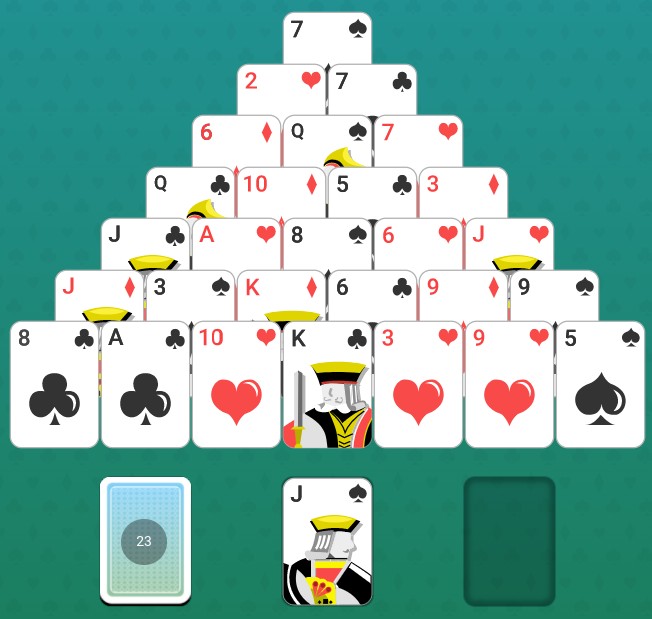
Pyramid Solitaire uses a standard 52-card deck. At the start of the game, 27 of those cards are dealt on the tableau in the shape of a pyramid, with 7 cards making up the base. All cards are facing forward and they must overlap.
The remaining cards are combined to form the stockpile and are placed face down next to the player.
When the players draw a card from this pile, they must place it face forward next to it to create the waste pile. Once the stockpile has been completely transferred to the waste, the players can collect the cards, turn them face down and refill the stockpile once again.
The last area of the game stands to the right of the stock and waste pile: the foundation. This is a reserved space where the players will save the cards they have removed from the pyramid. Once a card has been placed in the foundation, it cannot be retrieved.
Pyramid Solitaire Card Values
Every card in Pyramid Solitaire has a fixed point value. To remove two cards from the pyramid, their values must add up to exactly 13. Suits and colors are irrelevant — only the rank matters. The King is the only card removed alone, since it equals 13 by itself.
| Card | Value | Pairs with | Combined total |
|---|---|---|---|
| Ace (A) | 1 | Queen (Q) | 13 |
| 2 | 2 | Jack (J) | 13 |
| 3 | 3 | 10 | 13 |
| 4 | 4 | 9 | 13 |
| 5 | 5 | 8 | 13 |
| 6 | 6 | 7 | 13 |
| 7 | 7 | 6 | 13 |
| 8 | 8 | 5 | 13 |
| 9 | 9 | 4 | 13 |
| 10 | 10 | 3 | 13 |
| Jack (J) | 11 | 2 | 13 |
| Queen (Q) | 12 | Ace (A) | 13 |
| King (K) | 13 | None — removed alone | 13 |
Suits do not affect pairing. A 5 of clubs pairs equally well with any 8, regardless of color or suit.
How to play
The goal in this game is to collect all the cards in the pyramid to clear the tableau. All the cards are facing forward and they overlap. Only the cards that do not have others on top of them can be played.
The players must collect two cards at a time, provided their sum equals 13. The numbered cards have their numerical value. As for the face cards, the king is worth 13, the queen 12, and the jack 11.
It is possible to match cards within the pyramid - as long as they are “free” - or to match them with the waste pile. Once the two cards have been sent to the foundation, they cannot return to the game. The king is the only card that can be sent alone to the foundation.
If there are no more moves available, the players can keep drawing cards from the stockpile and placing them on the waste looking for a possible match.
Pyramid Solitaire Win Rate
Pyramid Solitaire has one of the lowest win rates of any popular solitaire variant. Under strict rules — one pass through the stock pile, clearing all 52 cards — only about 0.5% to 2% of randomly dealt games are theoretically winnable. Under relaxed rules, where multiple passes are allowed and only the 28 pyramid cards need to be cleared, the win rate rises to roughly 5% to 30% depending on the platform.
The wide range in reported statistics reflects differences in ruleset, stock pile pass limits, and whether the platform filters for winnable deals before dealing.
Why is Pyramid Solitaire so hard to win?
The difficulty comes from how cards block each other. Each card in the pyramid covers two cards in the row below it. You cannot remove a buried card until both cards above it are gone — and those cards can only be removed if their specific numerical partner is available and exposed at the same time. Because only one card exists for each rank-pair (one 4 to match each 9, one Ace to match each Queen), a single unfavorable deal can make the game mathematically impossible before you make your first move.
Unlike FreeCell, where over 99% of deals are solvable with perfect play, Pyramid Solitaire is heavily luck-dependent. The arrangement of the deck at the start of the game determines whether a path to victory exists at all.
Pyramid Solitaire win rate vs. other solitaire games
| Game | Theoretically winnable | Actual player win rate | Luck vs. skill |
|---|---|---|---|
| FreeCell | ~99.999% | ~41% | Mostly skill |
| Klondike (Turn 1) | ~79% | 15–55% | Mixed |
| Klondike (Turn 3) | ~82% | 10–25% | Mixed |
| Spider (1 suit) | ~100% | 52–90% | Mostly skill |
| Spider (4 suits) | ~99% | 5–20% | Skill-heavy |
| TriPeaks | ~90% | ~70% | Mixed |
| Golf Solitaire | ~40% | 20–40% | Mostly luck |
| Pyramid Solitaire (strict) | 0.5–5% | 1–2% | Heavily luck |
| Pyramid Solitaire (relaxed) | ~30% | ~30% | Mixed |
Win rates vary by platform, ruleset, and player skill. Strict Pyramid = one stock pass, all 52 cards must be cleared. Relaxed Pyramid = multiple passes, only the 28 pyramid cards required.
Does skill affect your win rate in Pyramid Solitaire?
Yes, but less than in most other solitaire variants. Because many deals are unwinnable by design, the ceiling for skill improvement is lower than in FreeCell or Spider. That said, experienced players consistently outperform beginners by avoiding two key mistakes: using the wrong pair too early (which blocks a necessary card for the rest of the game), and drawing from the stock pile before exhausting all available pyramid pairs. On guaranteed winnable deals — like those on Solitaire 365 — smart pair selection is the primary factor separating wins from losses.
Tips to win at Pyramid Solitaire
Check the pyramid and your chances of winning
This game only uses one standard 52-card deck, which means you only have four cards of each value available.
Let’s say you have three 4s on the pyramid and they stand atop a 9. This means that you only have one 4 remaining in the stockpile. If you use it to remove another 9 on the pyramid, you can turn the game into one very hard win. You can even make it unwinnable if the 9 is under the 4s on the pyramid.
Likewise, if you have a 10 at the top of the pyramid, for example, and all the cards worth 3 points are also displayed on the tableau, you can immediately see that the game is unwinnable. You can only remove the 10 by matching it with a 3, but you first need to remove all the 3 to get to the 10 - impossible.
Just by looking at the pyramid when you start the game you can already perceive these difficulties and plan your strategy accordingly. As for unwinnable games, this online Pyramid Solitaire is designed to avoid such card dispositions, so you can always have fun playing.
Send the Kings to the foundation right away
The kings can be sent to the foundation by themselves as they are worth 13. Think of them as a “gift”.
This means that there is no reason to keep them around, especially if they are in the pyramid, blocking other cards.
Try to balance the pyramid
Try to remove the cards evenly on both sides of the pyramid to keep its base as wide as possible throughout the game.
The worst outcome that you can get is ending up with a line of overlapped cards. When this happens, you can only remove them by finding specific cards to match each one of them, once at a time. Although it is feasible if they are available in the stockpile, it can be boring.
Pyramid Solitaire Variants
Pyramid Solitaire has inspired a number of variations over the years. While all of them share the same core mechanic — pairing cards that add up to 13 — each variant changes something about the layout, the stock rules, or the winning condition. Here is an overview of the most popular ones.
Classic Pyramid (Standard)
The standard version played on Solitaire 365. The tableau is a 7-row pyramid of 28 face-up cards. The remaining 24 cards form a stock pile, drawn one at a time. You win by clearing all 28 pyramid cards. Only one pass through the stock pile is allowed in strict mode.
Relaxed Pyramid
An easier version where multiple passes through the stock pile are permitted. This increases the win rate significantly and is the recommended mode for beginners. The layout and pairing rules remain identical to the standard game.
Tut's Tomb (King Tut)
One of the oldest and most popular variants, originally featured in the Microsoft Entertainment Pack 2 in 1990 under the name "Tut's Tomb". In this version, three cards are drawn from the stock pile at once instead of one, and unlimited redeals are allowed. The King of Spades is traditionally placed at the top of the pyramid to represent King Tutankhamun.
Solitaire 13
An alternative name for Classic Pyramid Solitaire, referring directly to the rule that all pairs must sum to 13. The gameplay is identical to the standard version. Some online platforms and mobile apps use this name instead of Pyramid Solitaire.
Giza
A fully open variant invented by solitaire designer Michael Keller. Instead of a face-down stock pile, the remaining 24 cards are dealt face-up into 8 piles of 3 cards each. Because all cards are visible from the start, Giza is a game of pure strategy with no hidden information — and is considered significantly harder to win.
Apophis Solitaire
A variant that uses a single deck but provides three waste piles instead of one. Having three available waste cards at any time gives players more pairing options and increases the win rate compared to Classic Pyramid.
Cheops Pyramid
A stricter variant where only one pass through the stock pile is allowed and pairs must consist of consecutive ranks (e.g., a 7 pairs with a 6 or an 8) rather than cards summing to 13. Only one redeal is permitted, which demands careful planning from the very first move.
Pyramid Dozen
Identical to Classic Pyramid in layout and rules, with one change: pairs must add up to 12 instead of 13. This shifts the card value assignments — the Queen becomes the solo card (worth 12), and all other pairs adjust accordingly.
Pyramid Solitaire vs. Other Solitaire Games
Pyramid Solitaire belongs to a different family of solitaire games than most people are familiar with. While classic solitaire variants like Klondike or FreeCell ask you to build ordered sequences by suit and rank, Pyramid Solitaire is built entirely around a single arithmetic rule: pair any two exposed cards that add up to 13. Understanding how Pyramid compares to other popular variants helps you choose the right game for your mood — and sharpens your strategy in each one.
Pyramid Solitaire vs. Klondike Solitaire
Klondike is the version most people simply call "Solitaire." The goal is to move all cards to four foundation piles ordered by suit, from Ace to King. You build tableau columns in alternating colors and descending rank. In Pyramid, there are no sequences to build and suits are completely irrelevant. You scan the exposed cards for pairs that sum to 13, remove them, and repeat. Klondike rewards pattern recognition and long-term planning across multiple columns; Pyramid rewards arithmetic awareness and knowing which pairs to prioritize.
Klondike has a win rate of roughly 80% in Turn 1 mode. Pyramid Solitaire wins only 1–2% of the time under strict rules — making it one of the hardest solitaire variants despite its simple premise.
Pyramid Solitaire vs. FreeCell
FreeCell is almost entirely skill-based: over 99% of deals are theoretically solvable, and the four open "free cells" give you full control over the tableau. Every card is visible from the start, so FreeCell rewards deep planning and is rarely lost by accident. Pyramid Solitaire has a much stronger luck component — the distribution of matching pairs across the pyramid and stock pile often determines the outcome before you make your first move. Where FreeCell punishes careless sequencing, Pyramid punishes using the wrong pair too early.
Pyramid Solitaire vs. Spider Solitaire
Spider Solitaire uses two decks and 10 tableau columns. The goal is to build complete sequences from King to Ace in the same suit, then move them to the foundation. It is a long, complex game that can take 20–30 minutes. Pyramid Solitaire is short and fast — most games last under five minutes. Spider in 4-suit mode has a win rate below 10%, comparable to strict Pyramid, but the skill ceiling in Spider is much higher because more moves are reversible through careful sequencing.
Pyramid Solitaire vs. TriPeaks Solitaire
TriPeaks is the closest relative to Pyramid in terms of layout: cards are arranged in a tableau you clear from the top down. However, TriPeaks uses three separate peaks and a completely different removal rule — you discard cards that are one rank higher or lower than the top of the waste pile, building a chain. There is no arithmetic, no summing to 13, and suits still don't matter. TriPeaks is faster and more chain-focused; Pyramid requires more deliberate pair selection.
Pyramid Solitaire vs. Golf Solitaire
Golf Solitaire also involves clearing a tableau by playing cards to a waste pile, but the rule is sequential rank rather than arithmetic pairs. You can only play a card that is one rank above or below the current waste card. Golf is driven by chain-building and is generally easier to win than Pyramid. Neither game involves suit matching, and both are short-form games suited for quick sessions.
| Game | Core mechanic | Suits matter? | Decks | Approx. win rate | Skill vs. luck |
|---|---|---|---|---|---|
| Pyramid Solitaire | Pair cards summing to 13 | No | 1 | 1–30% (rule-dependent) | Mixed |
| Klondike Solitaire | Build suit sequences A–K | Yes | 1 | ~80% (Turn 1) | Mixed |
| FreeCell | Sequence with 4 free cells | Yes | 1 | >99% | Mostly skill |
| Spider Solitaire | Build K–A same-suit sequences | Yes (4-suit) | 2 | <10% (4-suit) | Mostly skill |
| TriPeaks Solitaire | Chain ±1 rank cards | No | 1 | ~70% | Mixed |
| Golf Solitaire | Play ±1 rank to waste pile | No | 1 | ~40% | Mostly luck |
Pyramid Solitaire — Frequently Asked Questions
How do you win Pyramid Solitaire?
To win, you must remove all 28 cards from the pyramid by pairing exposed cards that add up to 13. The King (worth 13) is removed alone. Use the stock pile when no pairs are available on the pyramid.
What cards pair together in Pyramid Solitaire?
Pairs must total exactly 13: Ace (1) + Queen (12), 2 + Jack (11), 3 + 10, 4 + 9, 5 + 8, 6 + 7. The King (13) is removed by itself. Suits and colors don't matter — only the card values count.
Can every game of Pyramid Solitaire be won?
No — not every deal is solvable. Under strict rules, only about 1–2% of games can be won. In relaxed versions (clearing only the pyramid, not the stock pile), win rates are around 30%. Our version only generates winnable deals.
What is the win rate of Pyramid Solitaire?
The win rate varies by ruleset. Under strict rules (clearing all 52 cards), it's roughly 1–2%. Under relaxed rules (clearing only the 28 pyramid cards), players win about 30% of the time. It's one of the harder solitaire variants.
What is Pyramid Solitaire also known as?
Pyramid Solitaire is also called Tut's Tomb and Solitaire 13. These names refer to the same core game: pairing exposed cards that sum to 13 in order to clear a pyramid-shaped layout.
How many cards are in the pyramid?
The pyramid is made up of 28 face-up cards arranged in 7 overlapping rows — 1 card at the top, down to 7 cards at the base. The remaining 24 cards form the stock pile.
Can you undo moves in Pyramid Solitaire?
Yes — our online version supports unlimited undos. You can reverse any move and try a different pairing without restarting the game. This is especially useful when learning strategy.
What is the difference between Pyramid Solitaire and Klondike Solitaire?
In Klondike, you build ordered sequences by suit and rank. In Pyramid Solitaire, you pair any two exposed cards that add up to 13, regardless of suit or color. Pyramid is based on simple addition; Klondike is based on sequencing.
How do you play the King in Pyramid Solitaire?
The King has a value of 13, which equals the target sum on its own. Simply click or tap the King to send it directly to the foundation — no pairing needed. Remove Kings as soon as they are exposed, since they block two cards beneath them.
Is Pyramid Solitaire free to play online?
Yes. You can play Pyramid Solitaire for free at Solitaire 365 — no download, no sign-up required. The game works on desktop and mobile browsers and includes unlimited undos and guaranteed winnable deals.
Check our latest articles
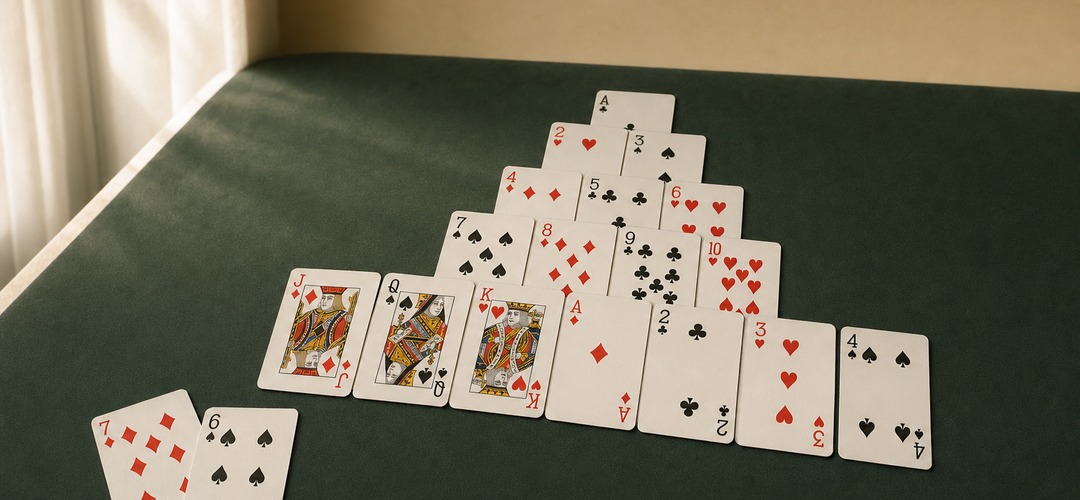
How to Play Pyramid Solitaire: Rules & Strategy
Pyramid Solitaire is a single-player card game where the goal is to clear a pyramid-shaped tableau by removing exposed cards that add up to 13. Unlike Solitaire, where you build foundations by suit, Pyramid Solitaire is based on pairing card values. You play by looking for uncovered cards in the…

The most popular 6 types of Solitaire games
The term Solitaire is often wrongly used to refer to a specific kind of card game known as Klondike or Patience in the UK. In reality, there are several types of Solitaire games. Klondike is still the most popular version of the game. After all, it was the first to…

Advanced FreeCell Strategy: How to Win (Almost) Every Single Game
Have you ever stared at a FreeCell board, completely blocked, wondering if the game was rigged? It’s a frustrating feeling, but here is a mind-blowing fact to kickstart your confidence: in the original Windows 95 version of FreeCell, out of 32,000 numbered deals, only one single game was proven to…

Hardest Solitaire Games: 21 Challenging Variants Ranked
The hardest solitaire games are not always the ones with the most complicated rules. Some are difficult because they give you very few recovery options. Others are hard because they require long-term planning, strict suit-building, careful stock management or a good deal of patience when the cards do not cooperate.…