Play Solitaire online for free, directly in your browser. Enjoy classic Klondike Solitaire with no sign-up, no download, and smooth gameplay on desktop, tablet, or mobile.
✅ Free · ✅ No sign-up · ✅ No download · ✅ Turn 1 or Turn 3 · ✅ Mobile-friendly
Play classic Solitaire online on Solitaire 365
This is classic Klondike Solitaire, the version most players think of when they search for Solitaire. Your goal is to move all cards to the four foundation piles, sorted by suit from Ace to King.
Choose Turn 1 for an easier game or Turn 3 for a more strategic challenge. Both modes are available instantly, so you can start a new game whenever you want.
Solitaire Setup

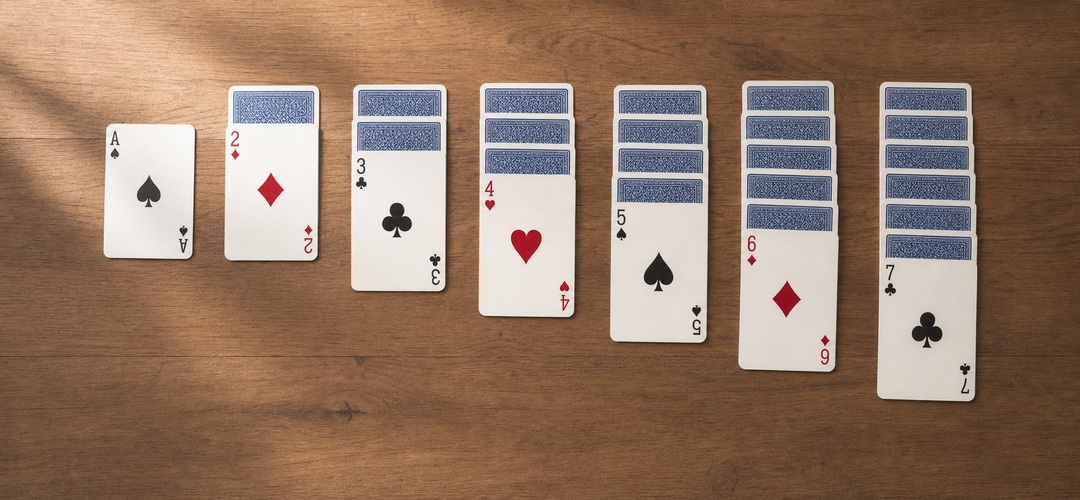
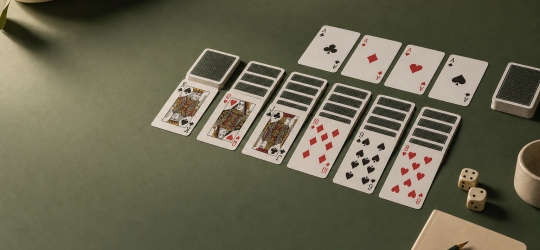
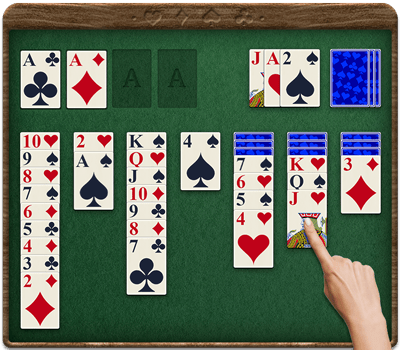
Classic Solitaire is played with a standard 52-card deck. At the start of the game, the cards are arranged into four main areas: the tableau, stockpile, waste pile, and foundation piles.
- Tableau: the main area of play, made up of seven columns. The first column has one card, the second has two cards, the third has three cards, and so on until the seventh column has seven cards.
- Stockpile: the remaining 24 cards, placed face-down. You draw from the stockpile when you need new cards.
- Waste pile: the place where cards from the stockpile are turned face-up.
- Foundation piles: four empty piles, one for each suit, built in order from Ace to King.
Only the top card in each tableau column is face-up at the beginning. As you move cards, hidden cards are revealed and become available to play.
How to play Solitaire
The goal of Solitaire is to move all 52 cards to the four foundation piles. Each foundation starts with an Ace and is built in ascending order up to the King.
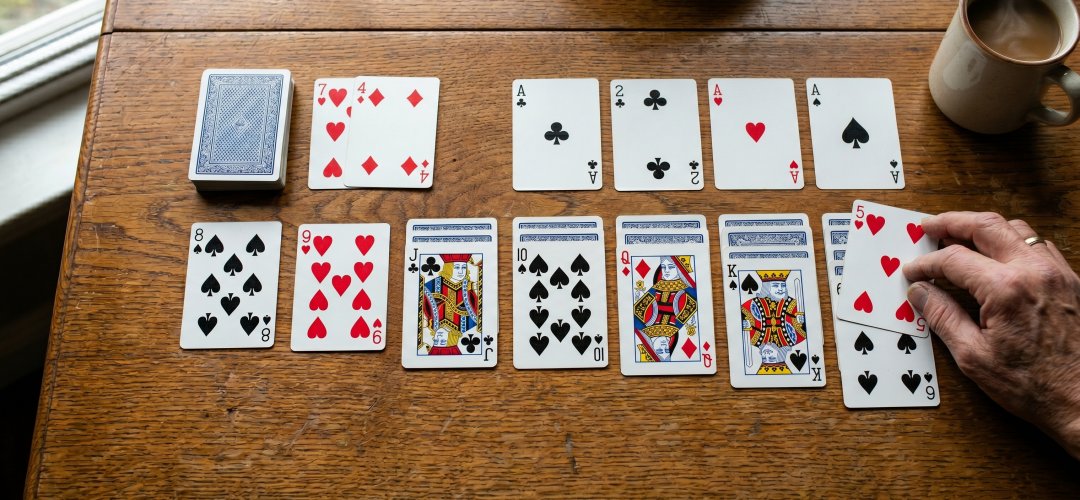
- Look for available moves in the seven tableau columns.
- Move face-up cards in descending order while alternating colors.
- Reveal face-down cards whenever possible.
- Draw from the stockpile when you run out of useful tableau moves.
- Build each foundation pile by suit from Ace to King.
Only Kings, or sequences that start with a King, can be moved into an empty tableau column. This makes empty columns valuable, especially when a King is blocking hidden cards.
Solitaire rules
Solitaire rules are simple, but each move can affect the rest of the game. Understanding the basic rules will help you make better decisions and avoid getting stuck.
- Move only face-up cards: face-down cards must be uncovered before they can be played.
- Build tableau sequences in descending order: for example, a 9 can be placed on a 10.
- Alternate colors in the tableau: red cards go on black cards, and black cards go on red cards.
- Move sequences when allowed: if a group of cards is already ordered correctly, you can move the sequence together.
- Start foundations with Aces: each foundation pile begins with an Ace and continues by suit up to the King.
- Use Kings for empty columns: only a King, or a valid sequence starting with a King, can fill an empty tableau column.
- Draw from the stockpile when stuck: if there are no useful moves in the tableau, turn cards from the stockpile to the waste pile.
You win when every card has been moved to the foundation piles in the correct order.
Turn 1 vs Turn 3 Solitaire
Solitaire 365 lets you play classic Klondike Solitaire in Turn 1 or Turn 3 mode.
| Mode |
Best for |
Difficulty |
| Turn 1 Solitaire |
Beginners and quick games |
Easier |
| Turn 3 Solitaire |
Experienced players |
Harder |
In Turn 1, you draw one card at a time from the stockpile. This gives you more control and makes it easier to find playable cards.
In Turn 3, you draw three cards at a time but can only play the top card. This makes the game more challenging because some cards may stay blocked until you move the cards above them.
If you are new to Solitaire, start with Turn 1. If you want a more strategic game, choose Turn 3.
Solitaire strategies to win more games
Solitaire depends partly on the deal, but smart decisions can help you win more often.
- Reveal face-down cards as early as possible: hidden cards limit your options, so uncovering them should be a priority.
- Focus on longer tableau columns first: longer columns usually hide more cards and can block progress if ignored.
- Do not move cards to the foundations too early: some cards may still be useful in the tableau for building sequences.
- Use empty columns carefully: empty spaces are powerful, but only if you can place a King or King-led sequence there.
- Check the tableau before drawing from the stockpile: you may already have a useful move available.
- Think a few moves ahead: the best move is not always the most obvious one.
- Use undo to test alternatives: if a move does not help, go back and try another path.
The more you play, the easier it becomes to recognize useful patterns and avoid moves that block future progress.
Common mistakes in Solitaire – beginner errors to avoid
Whether you play Draw 1 or Draw 3, most lost games come from a handful of predictable mistakes rather than bad luck. Below are the most frequent errors players make in Klondike Solitaire, along with why they hurt your chances of winning.
1. Moving cards to the foundation too early
One of the biggest beginner mistakes is sending cards (especially mid-value cards like 3–7) to the foundation as soon as possible. This can block useful sequences in the tableau and reduce flexibility later in the game.
2. Ignoring face-down cards
Focusing only on visible moves while leaving hidden cards untouched is a common trap. The game is usually won by uncovering tableau columns, not by making surface-level moves.
3. Playing without thinking ahead
Many players make the first available move without considering consequences. This often leads to blocked columns or wasted opportunities that only become obvious a few moves later.
4. Emptying columns without a King ready
Creating an empty tableau space is powerful—but only if you can immediately place a King (or a King-led sequence). Otherwise, the empty column becomes useless and wastes a key strategic slot.
5. Overusing the stock pile too quickly
Cycling through the deck without first exploring tableau moves reduces control over the game flow. Good players treat the stock as a backup, not the first option.
6. Building “pretty” stacks instead of useful ones
Some moves look good in the short term (clean sequences, tidy columns), but actually reduce future flexibility. For example, locking a useful card under a long sequence can limit later options.
7. Filling empty spaces too early
Dropping the first available King into an empty column without strategy can block better future combinations. Experienced players often wait for the King that unlocks the most useful structure.
Solitaire, Klondike, and Patience: what’s the difference?
Solitaire is the broad name for single-player card games. Klondike is the specific version most people mean when they say Solitaire. Patience is another name for the same type of game, especially in the UK and some other countries.
So if you are looking for classic Solitaire, online Solitaire, Klondike Solitaire, or Patience, you are probably looking for the same familiar card game: move cards in alternating colors, reveal hidden cards, and build the foundations from Ace to King.
History of Solitaire
Solitaire is one of the oldest and most popular card games in the world. Although its exact origins remain uncertain, historians generally believe that Solitaire first appeared in Europe during the late 18th century. Early references to the game were found in France and Germany, where it was commonly known as "Patience" because success often required careful planning and persistence.
During the 19th century, Solitaire became especially popular among the European aristocracy. Books dedicated to card games began including detailed Solitaire rules and strategies, helping spread the game across France, England, and other parts of Europe. By the late 1800s, numerous Solitaire variations had emerged, including games that would later inspire modern favorites such as Klondike, Spider Solitaire, and FreeCell.
The version most people know today is Klondike Solitaire. Its rise in popularity is often linked to the Klondike Gold Rush in the Yukon region of Canada during the late 1890s. While the exact connection remains debated, the game became widely associated with prospectors and adventurers seeking fortune, and the name "Klondike" has remained ever since.
Solitaire reached an even larger audience in the 20th century. Printed card game collections introduced millions of players to different Solitaire variants, and the game became a popular pastime because it could be played alone without requiring opponents or special equipment.
The biggest milestone in Solitaire history came in 1990 when Microsoft included Klondike Solitaire with Windows 3.0. Originally designed to help users become familiar with computer mouse controls such as dragging and dropping, the game quickly became one of the most played computer games of all time. For many people, Solitaire was their first gaming experience on a personal computer.
Today, Solitaire continues to be enjoyed by millions of players worldwide. Thanks to online platforms, mobile devices, and browser-based games, classic Solitaire remains as popular as ever. Players can enjoy traditional Klondike Solitaire as well as dozens of variations, including Spider Solitaire, FreeCell, Pyramid Solitaire, TriPeaks Solitaire, Golf Solitaire, and many others.
More than two centuries after its creation, Solitaire remains a timeless card game that combines strategy, planning, and a little luck, making it one of the most enduring games ever invented.
Popular Solitaire Variations
While classic Klondike Solitaire is the most popular version of the game, there are dozens of Solitaire variations enjoyed by players around the world. Each variant introduces unique rules, layouts, and strategies while preserving the core objective of organizing cards according to specific patterns. Whether you prefer skill-based challenges, fast-paced gameplay, or more complex puzzles, there is a Solitaire game for every type of player.
Spider Solitaire
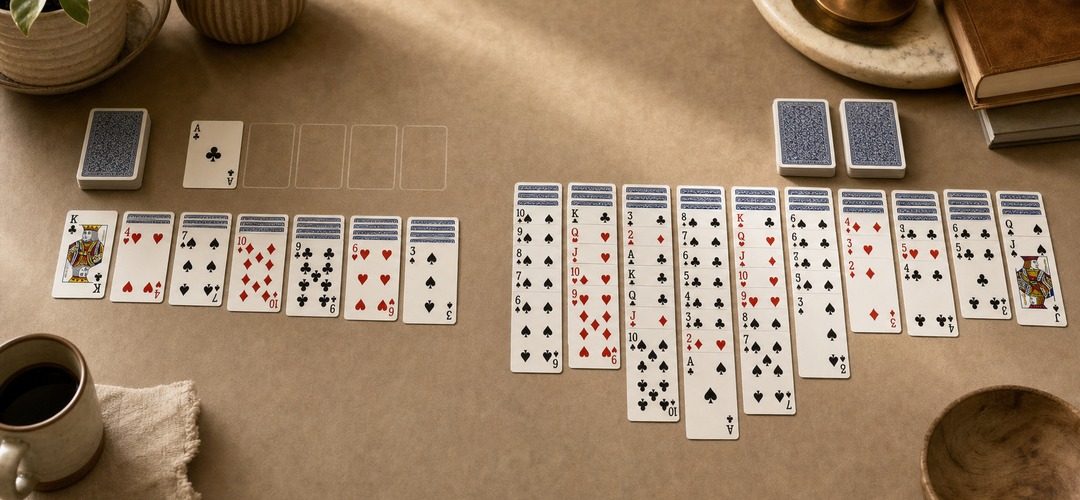
Spider Solitaire is one of the most widely played Solitaire variants. Unlike Klondike, it uses two decks of cards and requires players to build complete sequences from King to Ace within the tableau. Spider Solitaire is generally considered more challenging than classic Solitaire and rewards careful planning and long-term strategy.
FreeCell Solitaire
FreeCell Solitaire is known for its emphasis on skill rather than luck. Nearly every deal can be solved with the right moves. Players use four free cells as temporary storage spaces to maneuver cards around the tableau. Because all cards are visible from the start, FreeCell is often considered one of the most strategic Solitaire games.
Pyramid Solitaire
Pyramid Solitaire uses a distinctive pyramid-shaped layout. The objective is to remove pairs of cards that add up to 13 until the entire pyramid is cleared. This variation combines simple rules with challenging decision-making and is especially popular among casual players.
TriPeaks Solitaire
TriPeaks Solitaire features three overlapping card pyramids, or peaks. Players remove cards that are one rank higher or lower than the current card in play. The fast pace and frequent scoring opportunities make TriPeaks one of the most entertaining and beginner-friendly Solitaire variations.
Golf Solitaire
Golf Solitaire is another quick and accessible version of Solitaire. Cards can be removed if they are one rank above or below the top card of the waste pile. The game focuses on creating long sequences and clearing the tableau efficiently, making it ideal for short gaming sessions.
Yukon Solitaire
Yukon Solitaire resembles Klondike but allows groups of face-up cards to be moved regardless of their order. This creates a very different strategic experience where players have greater freedom but must think several moves ahead to succeed.
Forty Thieves Solitaire
Forty Thieves Solitaire is one of the most difficult Solitaire games. Played with two decks, it requires players to build foundation piles by suit while dealing with limited movement options. Winning rates are much lower than in Klondike, making it a favorite among experienced players seeking a challenge.
Canfield Solitaire
Canfield Solitaire is a classic American Solitaire game famous for its difficulty. Players start with a reserve pile and must carefully manage limited opportunities to build the foundations. Although challenging, Canfield remains one of the most respected traditional Solitaire variants.
Aces Up Solitaire
Aces Up Solitaire has simple rules but surprisingly deep strategy. The goal is to remove all cards except the four aces by discarding lower-ranked cards of the same suit. Games are quick to play, making Aces Up a popular choice for players looking for a fast challenge.
Addiction Solitaire
Addiction Solitaire offers a unique puzzle-like experience. Players rearrange cards within rows to create sequences of the same suit. Unlike many traditional Solitaire games, success depends heavily on planning and card positioning rather than building foundation piles.
Which Solitaire Variation Should You Play?
If you enjoy the classic experience, Klondike Solitaire remains the best place to start. Players seeking a greater challenge often prefer Spider Solitaire or Forty Thieves, while those who enjoy skill-based gameplay tend to favor FreeCell. For faster games, TriPeaks Solitaire, Golf Solitaire, and Aces Up Solitaire are excellent choices. Exploring different Solitaire variations is one of the best ways to improve your card-playing skills while discovering new strategic challenges.
Solitaire vs Other Games
| Game |
Decks Used |
Objective |
Difficulty |
Skill vs Luck |
Best For |
| Klondike Solitaire |
1 |
Build four foundation piles from Ace to King by suit |
Medium |
Balanced |
Most players and beginners |
| Spider Solitaire |
2 |
Create complete King-to-Ace sequences in the tableau |
Hard |
More Skill |
Experienced players |
| FreeCell Solitaire |
1 |
Move all cards to the foundations using free cells |
Medium |
Mostly Skill |
Strategic thinkers |
| Pyramid Solitaire |
1 |
Remove card pairs that total 13 |
Medium |
Balanced |
Casual players |
| TriPeaks Solitaire |
1 |
Clear three peaks by removing sequential cards |
Easy |
More Luck |
Fast-paced gameplay |
| Golf Solitaire |
1 |
Clear the tableau using cards one rank higher or lower |
Easy to Medium |
Balanced |
Quick games |
| Yukon Solitaire |
1 |
Move all cards to the foundations with fewer restrictions |
Hard |
More Skill |
Advanced players |
| Forty Thieves Solitaire |
2 |
Build foundation piles by suit from two decks |
Very Hard |
More Skill |
Expert players |
Why play Solitaire online on Solitaire 365?
Solitaire 365 is built for fast, simple, and familiar gameplay. You can open the game and start playing right away, without account creation, app installation, or unnecessary steps.
The experience stays close to the classic Solitaire game players already know: clear cards, simple controls, familiar rules, and quick access to a new deal whenever you want.
Solitaire 365 also gives you useful controls such as undo, restart, new game, settings, card size adjustment, and daily challenges. These features make it easy to play a quick game or spend more time improving your strategy.
And if you want a reason to come back every day, the Solitaire Daily Challenge gives you a new free Klondike puzzle every 24 hours — with a Gold Trophy waiting at the end of a perfect month.
Frequently asked questions about Solitaire
Can I play Solitaire for free?
Yes. You can play Solitaire online for free on Solitaire 365, with no sign-up and no download required.
Is this classic Klondike Solitaire?
Yes. This is classic Klondike Solitaire, the most popular version of Solitaire.
What is the difference between Turn 1 and Turn 3 Solitaire?
In Turn 1, you draw one card at a time from the stockpile. In Turn 3, you draw three cards at a time and can only play the top card, making the game harder.
Can I play Solitaire on mobile?
Yes. Solitaire 365 works on desktop, tablet, and mobile browsers.
Do I need to download an app?
No. You can play directly in your browser without installing anything.
Is Solitaire the same as Patience?
In many countries, yes. Solitaire is also called Patience, especially in the UK. Klondike is the classic version most people mean when they say Solitaire.
What is the basic Solitaire setup?
Classic Solitaire uses seven tableau columns, a stockpile, a waste pile, and four foundation piles. The tableau starts with 28 cards, and the remaining 24 cards form the stockpile.
How do I win Solitaire?
To win Solitaire, move all cards to the foundation piles by suit, from Ace to King. Revealing hidden cards and managing empty columns are key strategies.
Is every Solitaire game winnable?
No. Some deals may not be winnable, even with perfect play. However, good strategy can improve your chances and help you recognize better moves.
About Solitaire 365
We want to offer users the opportunity to comfortably play their favorite card games online. We are not trying to reinvent the wheel. We want to remain faithful to the true essence of the solitaire games, keeping them as close as possible to the versions and gameplay that everyone already knows and loves. Our goal is to offer free online solitaire games and apps with a clean, straightforward design and a simple interface that makes them simple to use, so users can play their favorite challenges right away without having to navigate through different menus and options.
We hope you enjoy your visit and that you have fun!


 10 days