Play free Russian Solitaire online, directly in your browser. Enjoy this classic card game with no sign-up, no downloads, and smooth gameplay on desktop, tablet, or mobile.
✅ Free · ✅ No sign-up · ✅ No download · ✅ Mobile-friendly · ✅ Fullscreen
About Russian Solitaire
Russian Solitaire is a card game inspired by Yukon Solitaire, but with one rule that changes everything. The goal is the same as in most patience games: build the four foundations upward by suit, from Ace to King. As in Yukon, all the cards are dealt onto the tableau, there is no stockpile, and you can move groups of cards even when they are not in perfect sequence. The crucial difference is that, on the tableau, cards must be built down in the same suit rather than in alternating colors.
That single change makes Russian Solitaire one of the most demanding single-deck games you can play. Because every sequence must follow one suit, your options shrink dramatically, hidden cards become much harder to reach, and a careless move can end the game on the spot. With a win rate of roughly one hand in forty, Russian Solitaire is the natural next challenge for anyone who has already mastered Klondike or Yukon. You can play it here for free, online, with no download and no sign-up.
Russian Solitaire Rules
Understanding the rules of Russian Solitaire is the key to mastering this challenging and rewarding card game. While Russian Solitaire is closely related to Yukon Solitaire, its strict suit-based building rule creates a very different experience that demands careful planning and disciplined play.
The objective of Russian Solitaire is to move all 52 cards to the four foundation piles. Each foundation must be built upward by suit, starting with the Ace and ending with the King.
The Deal and Layout
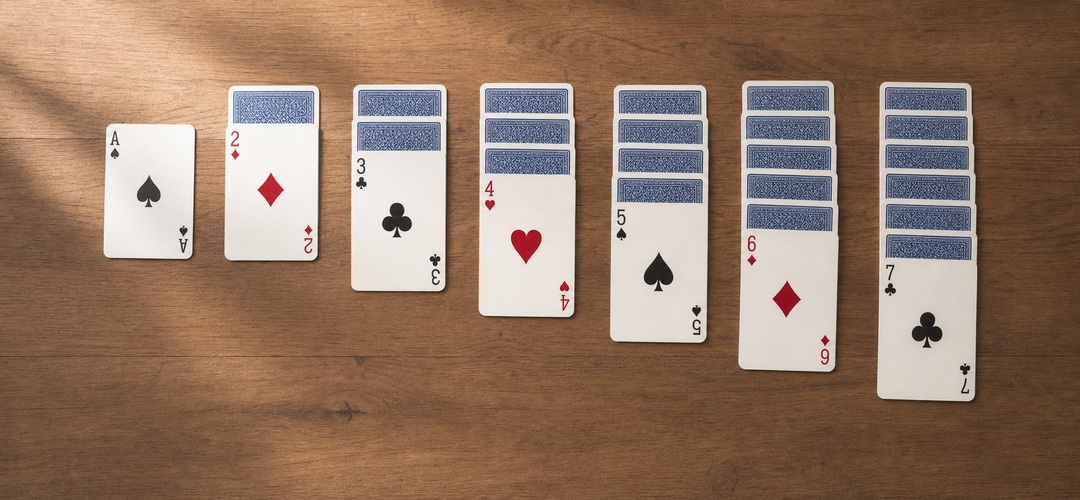
Russian Solitaire uses a single 52-card deck dealt into seven tableau columns, with four empty foundation piles waiting at the top. The first column holds a single face-up card. Each of the remaining six columns is dealt with one or more face-down cards followed by five face-up cards, so that the columns grow longer from left to right.
In practice, this means the leftmost column contains one card and the rightmost column contains eleven, with the last five cards of every column visible from the start. There is no stockpile and no waste pile, so every card you will ever play is already on the table the moment the game begins.
Building the Tableau
Cards in the tableau are built downward in descending rank and must follow the same suit. For example, a 6 of spades can be placed on a 7 of spades, and a 5 of spades can then be placed on the 6 of spades.
Valid moves include:
- Placing a 9 of hearts on a 10 of hearts.
- Placing a 4 of clubs on a 5 of clubs.
- Moving a complete descending sequence that follows a single suit.
Moves that would be legal in Yukon or Klondike — such as placing a black 5 on a red 6 — are not allowed here. Every card you stack onto another must match its suit, which is what makes Russian Solitaire so restrictive.
Moving Groups of Cards
Like Yukon, the most distinctive feature of Russian Solitaire is that groups of cards can be moved even when the cards within the group are not arranged in perfect sequence.
As long as the bottom card of the moving group can legally be placed onto another tableau pile, the entire stack may be moved together, including any cards lying on top of it. This allows you to relocate large portions of the tableau at once and is essential for uncovering the face-down cards buried beneath.
For example, if a 7 of diamonds is the bottom card you want to move, the whole stack resting on it travels along to an 8 of diamonds, even if the cards above the 7 are not in order.
Moving Cards to the Foundations
Foundation piles are built upward by suit:
- Ace → 2 → 3 → 4 → 5 → 6 → 7 → 8 → 9 → 10 → Jack → Queen → King
- All cards in a foundation must belong to the same suit.
Whenever an Ace becomes available, it can be moved to start a foundation pile. Additional cards of the same suit may then be added in ascending order. Because the tableau is already built by suit, sending cards to the foundations rarely costs you flexibility — which is one of the few ways Russian Solitaire is kinder than other games.
Empty Tableau Columns
When a tableau column becomes empty, only a King or a group of cards headed by a King may be moved into that space.
Creating an empty column can be valuable because it gives you somewhere to park sequences and uncover hidden cards. However, an empty column is only useful if you have a King ready to fill it — otherwise it simply reduces the room you have to maneuver.
No Stockpile or Waste Pile
Unlike Klondike Solitaire, Russian Solitaire does not use a stockpile or waste pile. All cards are dealt onto the tableau at the beginning of the game, and every move must be made using the cards already in play.
Because there are no extra cards to draw and no second chances, success depends entirely on planning ahead, revealing hidden cards early, and making the most efficient use possible of every tableau space.
Winning the Game
You win Russian Solitaire when all 52 cards have been moved from the tableau to the four foundation piles, each complete from Ace to King in its suit. Victory requires balancing immediate opportunities with long-term planning, since the strict suit rule means a single hasty move can leave you with no legal plays at all.
How to Play Russian Solitaire
Russian Solitaire is a challenging variation of Yukon Solitaire that rewards careful planning and strategic thinking. The goal is to move all 52 cards to the four foundation piles, building each suit from Ace to King. There is no stockpile to draw from, so every move must be made using the cards already visible on the tableau.
Step 1: Understand the Layout
At the start of a Russian Solitaire game, all cards are dealt into seven tableau columns. Some cards are face down, while the last five cards in each column are face up from the beginning. Since there is no stockpile or waste pile, the tableau contains every card you will use throughout the game.
The four foundation piles begin empty and are built upward by suit, starting with the Aces.
Step 2: Reveal Hidden Cards
One of your first priorities should be uncovering face-down cards. Every hidden card limits your available moves, while every revealed card creates new opportunities. Before making a move, consider whether it will help expose additional cards in the tableau.
In Russian Solitaire, revealing hidden cards is almost always more valuable than rushing cards to the foundations, because the suit-building rule makes blocked columns especially difficult to recover.
Step 3: Build Tableau Columns by Suit
Cards on the tableau are arranged in descending rank within the same suit. For example:
- A 6 of spades can be placed on a 7 of spades.
- A 9 of hearts can be placed on a 10 of hearts.
- A Queen of clubs can be placed on a King of clubs.
Building long descending sequences in a single suit helps organize the tableau and creates the openings you need to reach buried cards.
Step 4: Move Card Groups Strategically
Russian Solitaire's most flexible feature is its movement system. You can move groups of cards even when the cards within the group are not arranged in perfect sequence.
The only requirement is that the bottom card of the moving group must legally fit onto the destination card — that is, one rank lower and the same suit. This rule lets you reorganize large portions of the tableau and dig out face-down cards that would otherwise stay locked away. Knowing when to move an entire stack is one of the most important skills in the game.
Step 5: Start Building the Foundations
Whenever an Ace becomes available, move it to a foundation pile. Foundations are built upward by suit:
- Ace → 2 → 3 → 4 → 5 → 6 → 7 → 8 → 9 → 10 → Jack → Queen → King
Because the tableau already builds by suit, moving cards to the foundations usually helps rather than hurts your position. Still, keep an eye on cards you might need to anchor a sequence before sending them away for good.
Step 6: Create Empty Columns
Clearing a tableau column creates an empty space that can only be filled by a King or a stack beginning with a King. These empty columns are powerful strategic tools because they give you extra room to rearrange cards and unlock new sequences.
Whenever possible, plan moves that help create empty columns — but only clear a column when you have a King ready to occupy it, or the open space will work against you.
Step 7: Complete All Four Foundations
Continue revealing hidden cards, reorganizing tableau columns by suit, and building the foundations until every card has been moved to its suit pile. The game is won when all four foundations contain complete sequences from Ace through King.
Successful Russian Solitaire players think several moves ahead, balancing short-term opportunities with long-term positioning. With no stockpile and a strict suit rule, careful planning and efficient use of the tableau are almost always the difference between victory and defeat.
Russian Solitaire vs Yukon Solitaire
Russian Solitaire and Yukon Solitaire are close cousins. They share the same deal, the same lack of a stockpile, and the same ability to move groups of cards that are not in perfect order. The decisive difference lies in how you build sequences on the tableau.
Key Differences
| Feature |
Russian Solitaire |
Yukon Solitaire |
| Tableau building |
Down by same suit |
Down by alternating color |
| Deck |
1 deck (52 cards) |
1 deck (52 cards) |
| Stockpile / waste |
None |
None |
| Group movement |
Yes, unordered groups allowed |
Yes, unordered groups allowed |
| Difficulty |
Harder |
Easier |
| Approx. win rate |
~2.5–3% |
~20–25% |
Gameplay Style
Russian Solitaire demands a higher level of discipline than Yukon. Because every sequence must follow one suit, you have far fewer legal moves at any moment, and reorganizing the tableau requires you to think several layers deep before committing.
Yukon, by allowing alternating colors, gives you roughly twice as many placement options for each card. That extra freedom makes Yukon noticeably more forgiving and a much better starting point for players new to this family of games.
Which Game Is Harder?
Russian Solitaire is significantly harder than Yukon. The suit-only building rule slashes your options and makes many deals unwinnable from the start. Where a Yukon player might find several ways out of a tight spot, a Russian Solitaire player often has just one — or none.
If Russian Solitaire feels punishing, that is by design. Mastering Yukon first is the best way to build the group-movement instincts you will need here.
Russian Solitaire vs Klondike Solitaire
Russian Solitaire and Klondike Solitaire — the classic version most people picture when they think of solitaire — sit at opposite ends of the difficulty scale. Both aim to build four foundations from Ace to King, but almost everything else differs.
Key Differences
| Feature |
Russian Solitaire |
Klondike Solitaire |
| Stockpile |
No stockpile (all cards dealt at the start) |
Uses a stockpile and waste pile |
| Tableau building |
Down by same suit |
Down by alternating color |
| Card movement |
Move groups even if not fully ordered |
Only correctly ordered sequences can be moved |
| Hidden information |
Many face-down cards, no draws to help |
Face-down cards, but the stock offers new cards |
| Difficulty |
Very hard and highly strategic |
More balanced and beginner-friendly |
Gameplay Style
Klondike relies on incremental discovery: when you run out of moves, you draw from the stockpile and hope for something useful. That built-in safety net introduces an element of chance and keeps casual games flowing.
Russian Solitaire offers no such relief. With every card visible from the start and no draws to bail you out, each decision has a permanent, direct impact on the whole tableau. It is a far more deterministic — and far less forgiving — experience.
Which One Should You Play?
If you want a relaxed game with a comfortable mix of luck and skill, Klondike Solitaire is the natural choice. If you are after a serious test of planning and patience where skill is almost everything, Russian Solitaire delivers one of the toughest challenges in the single-deck world.
Russian Solitaire strategies and tips
Focus on uncovering the face-down cards
Revealing hidden cards is the single most important habit in Russian Solitaire. Because the suit rule restricts your moves so heavily, a buried card you cannot reach can stall the entire game. Whenever you are choosing between two moves, favor the one that exposes a face-down card, and never lose sight of the card blocking a hidden one.
Clear the aces as soon as possible
Aces are the building blocks of the foundations and serve no purpose on the tableau, since no card can be placed on top of them. Send each Ace to its foundation the moment it becomes available. Getting them out of the way both starts your sequences and frees up space for more useful moves.
Build the foundations actively
Unlike many solitaire games, sending cards to the foundations rarely hurts you in Russian Solitaire, because the tableau is already organized by suit. As long as you are not stripping away a card you need to anchor a longer sequence, keep feeding the foundations throughout the game rather than hoarding cards on the tableau.
Do not free a column without a King
Kings are the only cards that can fill an empty space on the tableau. If you clear a column without a King ready to occupy it, you simply lose a place to work and reduce the number of moves available to you. Plan column clearances around the Kings you can actually use.
Plan ahead before every move
In Russian Solitaire, each card can only be covered by one specific card — the next one down in the same suit. That makes the game far less flexible than Yukon, where two cards can cover any given card. Before you move, trace the consequences two or three steps forward and make sure the move opens more doors than it closes.
Take advantage of the online features
Playing Russian Solitaire online lets you use trial and error to your advantage. When you are unsure which path to take, try one, then use the undo button to step back and explore the alternatives before settling on the best line. Hints can also help you spot moves that are easy to miss in such a tightly constrained game — an enormous advantage in a game where win rates are otherwise so low.
Common Mistakes Beginners Make in Russian Solitaire
Russian Solitaire punishes mistakes more harshly than almost any other single-deck game, because there is no stockpile to bail you out and the suit-only rule leaves so little room for error. Avoiding these common beginner traps will do more for your win rate than any single clever move.
Rushing cards to the foundations too early
New players often send cards to the foundations the instant they can, assuming progress is always good. In Russian Solitaire, a low card you ship off prematurely may be exactly the card you needed to anchor a tableau sequence and dig out a hidden card. Because the tableau already builds by suit, foundation building is usually helpful — but only once it no longer strips away cards you still need in play. Check the tableau first, then send cards up.
Emptying a column without a King to fill it
Clearing a column feels like an achievement, but an empty space you cannot use is a liability, not a reward. With no King — or a stack headed by a King — ready to move in, that gap simply shrinks the area you have to maneuver. Beginners frequently open columns for the sake of it and then find themselves with fewer legal moves than before. Only clear a column when you already know which King will occupy it.
Forgetting that cards must match suit, not color
The most common error of all is playing Russian Solitaire as if it were Yukon or Klondike. Placing a black 5 on a red 6 is legal in those games but illegal here — every tableau move must follow a single suit. Until the rule becomes second nature, double-check that the card you are moving truly matches the suit beneath it, not just the rank.
Ignoring the face-down cards
Beginners tend to shuffle visible cards back and forth chasing small gains while leaving stacks of face-down cards untouched. Every hidden card is a locked door, and in such a restrictive game an unreached card can quietly end the game. Make uncovering face-down cards your priority and favor moves that expose them, even when a flashier move is available.
Moving cards without a plan
In Russian Solitaire, each card can only ever be covered by one specific card — the next rank down in the same suit. Moving on impulse, without tracing the next few steps, often closes the very path you needed. Before committing, ask what each move unlocks and what it costs. A move that looks productive can easily leave you with no legal plays at all.
Not using undo and hints to learn
Many beginners treat a single misstep as a lost game. Playing online, you can undo a move and explore a different line, or use a hint to spot an option you overlooked. Using these features is not cheating — it is the fastest way to understand why certain moves work and to train the forward-planning instincts the game rewards.
Russian Solitaire Variants
Russian Solitaire belongs to the wider Yukon family and has its own related variations. These versions keep the core ideas — dealing every card to the tableau and moving groups without a stockpile — while adjusting the building rules, difficulty, or number of decks.
Double Russian Solitaire
Double Russian Solitaire uses two full decks of cards (104 cards) and a larger tableau with additional foundations. The same strict suit-building rule applies, but the sheer number of cards demands even more advanced planning and patience.
Triple Russian Solitaire
Triple Russian Solitaire raises the stakes further with three decks. It is a long, highly strategic version best suited to experienced players who want a marathon challenge built on the same suit-based mechanics.
Alaska Solitaire
Alaska Solitaire is a more flexible relative of Russian Solitaire. It keeps the suit-based layout but lets you build sequences both up and down in the same suit, giving you more movement options while remaining considerably harder than Klondike or Yukon.
Yukon Solitaire (Parent Game)
Yukon Solitaire is the game Russian Solitaire is based on. It uses the same deal and group-movement rules but builds by alternating color instead of suit, making it a more forgiving and beginner-friendly starting point.
Scorpion Solitaire (Related Variant)
Although not a direct Russian variant, Scorpion Solitaire shares similar tableau manipulation and sequence-building mechanics, including suit-based building, while adding its own rules around partially face-up columns.
Which Variant Should You Try?
If you are new to this family of games, start with Yukon Solitaire to learn group movement, then move to Russian Solitaire for the suit-based challenge. Alaska Solitaire is a good next step once you are comfortable, and Double or Triple Russian Solitaire offer serious depth for players who want the longest, most demanding games.
Russian Solitaire FAQs
What are the odds of winning Russian Solitaire?
Russian Solitaire is one of the hardest single-deck games, with a win rate of roughly 2.5–3% — about one winnable hand in forty. Skillful play and careful use of the undo button can lift your real-world results well above that baseline.
Is Russian Solitaire harder than Yukon?
Yes. Both games deal the same way and allow group movement, but Yukon lets you build down by alternating color, while Russian Solitaire forces you to build down in the same suit. That single restriction roughly halves your options and makes Russian Solitaire significantly harder to win.
What is the difference between Russian Solitaire and Yukon Solitaire?
The only meaningful difference is the tableau-building rule. Yukon builds down in alternating colors; Russian Solitaire builds down in the same suit. Everything else — the deal, the lack of a stockpile, and the ability to move unordered groups — is the same.
Can every game of Russian Solitaire be won?
No. Not every Russian Solitaire deal is solvable, and even winnable hands often have just one narrow path to victory. Part of the appeal is learning to recognize early whether a game can be saved or is already lost.
Is Russian Solitaire the same as Russian Bank?
No. They are completely different games. Russian Bank (also called Crapette) uses two decks and is played competitively by two players, whereas Russian Solitaire is a single-player, single-deck patience game.
Is there a stockpile in Russian Solitaire?
No. Russian Solitaire does not use a stockpile or waste pile. All 52 cards are dealt onto the tableau at the start, and every move must be made using the cards already in play.
What is the best strategy for Russian Solitaire?
The strongest approach is to uncover face-down cards early, clear the Aces quickly, build the foundations actively (since the tableau already builds by suit), and only open columns when you have a King to fill them. Planning several moves ahead is essential.
When can I move a King in Russian Solitaire?
Kings can only be moved into empty tableau columns. Because creating space is costly when you have no King to use it, plan your column clearances around the Kings you can actually move.
Is Russian Solitaire a game of luck or skill?
Russian Solitaire is primarily a game of skill, though the initial deal introduces some randomness and some hands are simply unwinnable. Most of the outcome depends on how well you plan moves, manage tableau space, and reveal hidden cards.