Spider Solitaire and FreeCell Solitaire are two of the most strategic solitaire games, but they feel very different once you start playing. Spider Solitaire is a longer sequencing game with two decks, 10 tableau columns, hidden cards, and difficulty levels based on suits. FreeCell is a more open logic puzzle where all 52 cards are visible from the start and four free cells help you reorganize the tableau.
If you enjoy longer games with more uncertainty, Spider Solitaire is usually the better fit. If you prefer clear information, careful planning, and a puzzle-like challenge, FreeCell is likely the stronger choice. Both games reward skill, but they test different habits: Spider Solitaire rewards patience and sequence-building, while FreeCell rewards foresight and efficient use of space.
Spider Solitaire vs FreeCell: The Short Answer
The main difference between Spider Solitaire and FreeCell is that Spider Solitaire uses two decks and asks you to build complete descending sequences, while FreeCell uses one deck, shows every card from the beginning, and gives you four free cells for temporary storage. Spider Solitaire is usually longer and more variable. FreeCell is usually more transparent and puzzle-driven.
| Feature | Spider Solitaire | FreeCell |
|---|---|---|
| Deck count | 2 decks, 104 cards | 1 deck, 52 cards |
| Starting layout | 10 tableau columns with some cards face down | 8 tableau columns with all cards face up |
| Hidden cards | Yes | No |
| Free cells | No dedicated free cells | 4 free cells for temporary card storage |
| Stock pile | Yes, usually dealt 10 cards at a time | No stock pile |
| Main goal | Build complete King-to-Ace sequences and remove them from the tableau | Move all cards to the foundations from Ace to King by suit |
| Difficulty | Adjustable with 1-suit, 2-suit, and 4-suit modes | Depends mostly on deal complexity and planning |
| Skill vs luck | Skill-heavy, but hidden cards and stock deals add uncertainty | Highly skill-based because every card is visible |
| Best for | Longer tactical games and players who like escalating difficulty | Logic puzzles and players who like full-information planning |
How Spider Solitaire Works
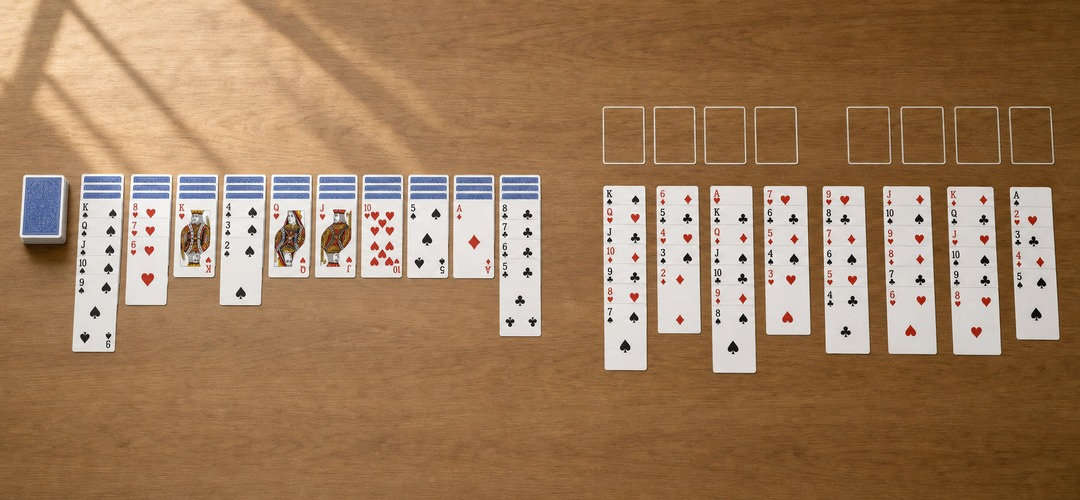
Spider Solitaire is usually played with 104 cards, which is the equivalent of two standard decks. The game starts with 10 tableau columns. Some cards are face down, and the top card of each column is face up. The remaining cards form a stock pile that can add a new card to every tableau column when you run out of useful moves.
The objective is to build complete descending sequences from King to Ace. In many digital versions, completed sequences are removed automatically from the tableau. To win, you need to clear all cards by completing every sequence.
Spider Solitaire Rules That Matter Most
In Spider Solitaire, you can usually place a card on another card that is one rank higher. For example, a 7 can be placed on an 8. The important detail is suit management. In easier 1-suit Spider, suit does not create much friction. In 2-suit and 4-suit Spider, mixed-suit sequences can help you temporarily, but clean same-suit sequences are much more powerful because they can be moved together.
Empty columns are especially valuable. They give you room to move cards, reorganize sequences, and reveal hidden cards. The biggest mistake many players make is drawing from the stock too early, because each stock deal adds one card to every column and can block carefully built sequences.
If you want a full step-by-step rules guide, read How to Play Spider Solitaire.
How FreeCell Works
FreeCell Solitaire uses one standard 52-card deck. All cards are dealt face up into 8 tableau columns at the start of the game. There is no stock pile and no hidden information, so every decision can be planned from the opening layout.
The objective is to move every card to the foundations from Ace to King by suit. The four free cells are temporary storage spaces. You can place one card in each free cell, which helps you move cards out of the way and unlock better sequences.
FreeCell Rules That Matter Most
In FreeCell, tableau cards are usually built down by alternating color. For example, a red 6 can be placed on a black 7. The free cells let you park individual cards, but they should not be treated as permanent storage. The more free cells you fill, the fewer options you have.
Empty tableau columns are also powerful in FreeCell. They increase your flexibility and can let you move longer sequences. Because every card is visible, FreeCell often feels less random than other solitaire games. When you lose, it is usually because your earlier moves limited your options.
If you want a full rules guide, read How to Play FreeCell Solitaire.
Rules Comparison: Spider Solitaire vs FreeCell
Spider Solitaire and FreeCell both belong to the wider family of solitaire games, but they are built around different rule systems. Spider is about building and clearing long sequences. FreeCell is about using limited temporary spaces to solve a visible card puzzle.
| Rule area | Spider Solitaire | FreeCell |
|---|---|---|
| Cards used | 104 cards | 52 cards |
| Tableau columns | 10 columns | 8 columns |
| Cards visible at the start | Only some cards are visible | All cards are visible |
| Stock pile | Yes | No |
| Temporary storage | Empty tableau columns | Four free cells and empty tableau columns |
| Tableau building | Descending order; same-suit sequences are strongest | Descending order by alternating color |
| Foundations or completed sequences | Complete King-to-Ace sequences are removed | Foundations are built Ace to King by suit |
| Main pressure point | Hidden cards and stock deals | Managing free cells and empty columns |
This is why the two games feel so different. Spider Solitaire creates pressure by hiding information and adding new cards. FreeCell creates pressure by showing everything but limiting how much space you have to reorganize the tableau.
Which Game Is Harder?
Spider Solitaire is usually harder than FreeCell when played in 2-suit or 4-suit mode. The extra deck, hidden cards, 10 columns, and stock deals create more uncertainty. A strong position can become blocked after a stock deal, so Spider often tests patience as much as pure calculation.
FreeCell can still be difficult, especially when the opening layout traps important low cards behind awkward sequences. But because all cards are visible, the challenge is more about planning than surprise. You can inspect the board, choose a strategy, and understand why a move works or fails.
The fairest answer is:
- 1-suit Spider Solitaire is often beginner-friendly.
- 2-suit Spider Solitaire is a clear step up in difficulty.
- 4-suit Spider Solitaire is usually harder than most casual FreeCell games.
- FreeCell Solitaire is more consistent, logical, and transparent.
Which Game Is More Skill-Based?
FreeCell is usually considered more skill-based because there is no hidden information. Every card is visible from the beginning, so good play depends on reading the tableau, preserving free cells, creating empty columns, and planning several moves ahead.
Spider Solitaire is also skill-based, but it includes more uncertainty. Hidden cards and stock deals can change the shape of the game. You still need strong strategy, but part of that strategy is risk management: deciding when to reveal cards, when to create an empty column, and when to delay a stock deal.
In simple terms, FreeCell is closer to a logic puzzle. Spider Solitaire is closer to a tactical endurance challenge.
Strategy Differences
The best strategy in Spider Solitaire is not the same as the best strategy in FreeCell. Both games reward planning, but they punish different mistakes.
| Strategy question | Spider Solitaire | FreeCell |
|---|---|---|
| What should you protect? | Empty columns and clean same-suit sequences | Free cells and empty columns |
| What should you avoid? | Drawing from the stock too early | Filling all free cells too early |
| What should you prioritize? | Revealing face-down cards | Keeping mobility and access to low cards |
| What creates flexibility? | Empty tableau columns | Empty tableau columns plus open free cells |
| What usually causes trouble? | Mixed suits, buried cards, and blocked columns | Poor free-cell management and blocked key cards |
Spider Solitaire Strategy
In Spider Solitaire, reveal hidden cards whenever it is safe to do so. Hidden cards are the main source of uncertainty, so each revealed card gives you more information and more options. Empty columns are another priority because they make it much easier to move sequences and reorganize the tableau.
Try not to draw from the stock until you have improved the board as much as possible. A new stock deal can cover useful cards and interrupt sequences. Before drawing, check whether you can reveal another card, create an empty column, or clean up a same-suit run.
FreeCell Strategy
In FreeCell, keep your free cells open for as long as possible. A free cell is useful because it gives you temporary flexibility, but a full free cell is also a limitation. If all four free cells are occupied, your move options can shrink quickly.
Look for ways to create empty tableau columns. An empty column often matters more than a single free cell because it can help you move longer sequences and restructure the board. Since every card is visible, take a moment at the start to identify blocked Aces, low cards, and long alternating-color sequences.
Which Game Is Better for Beginners?
FreeCell is often better for beginners who want to understand why they win or lose. Since every card is visible, the game teaches planning clearly. You can see the consequences of using a free cell too early or blocking an important card behind a poor sequence.
Spider Solitaire can also be beginner-friendly if you start with 1-suit mode. One-suit Spider reduces suit complexity and lets you focus on the core idea: build descending sequences, reveal cards, and create empty columns. Once that feels comfortable, 2-suit and 4-suit modes create a much deeper challenge.
If you are new to both games, start with FreeCell Solitaire for a logic-based introduction or Spider Solitaire in 1-suit mode for a more relaxed sequencing game.
Which Game Is Better for Experienced Players?
Experienced players may prefer Spider Solitaire because its difficulty can scale dramatically. Moving from 1-suit to 2-suit and then to 4-suit Spider changes the game from a comfortable card puzzle into a demanding long-form challenge.
Experienced players may prefer FreeCell if they enjoy precise problem-solving. FreeCell rewards efficient move order, careful use of free cells, and long-range planning. The board is visible, so the challenge is not finding hidden information. The challenge is using known information well.
If your goal is a harder session, choose 4-suit Spider Solitaire. If your goal is a cleaner logic puzzle, choose FreeCell Solitaire.
Spider Solitaire vs FreeCell: Which One Should You Choose?
Choose Spider Solitaire if you want a longer game with hidden cards, stock deals, and adjustable difficulty. It is the better choice if you enjoy building long sequences and managing uncertainty over time.
Choose FreeCell if you want a more transparent strategy game where every card is visible from the start. It is the better choice if you enjoy logic puzzles, careful planning, and efficient use of limited space.
The best option is to play both. Start a game of Spider Solitaire when you want a deeper sequencing challenge, and play FreeCell Solitaire when you want a full-information puzzle where every move matters.
Keep Practicing With Daily Challenges and Strategy Guides
If you want to compare both games in practice, daily challenges are a useful next step. Try Daily Spider Solitaire when you want a fresh sequencing challenge each day, or play Daily FreeCell Solitaire when you want a daily logic puzzle where every card is visible from the start.
You can also keep improving your Spider game with Spider Solitaire tips. If you want another comparison before choosing your next game, read Solitaire vs Spider Solitaire to see how Spider differs from classic Klondike.