Play Alaska Solitaire online for free. Can you clear the deck before the freeze sets in? Play now, no download required!
✅ Free · ✅ No sign-up · ✅ No download · ✅ Mobile-friendly · ✅ Fullscreen
About Alaska Solitaire
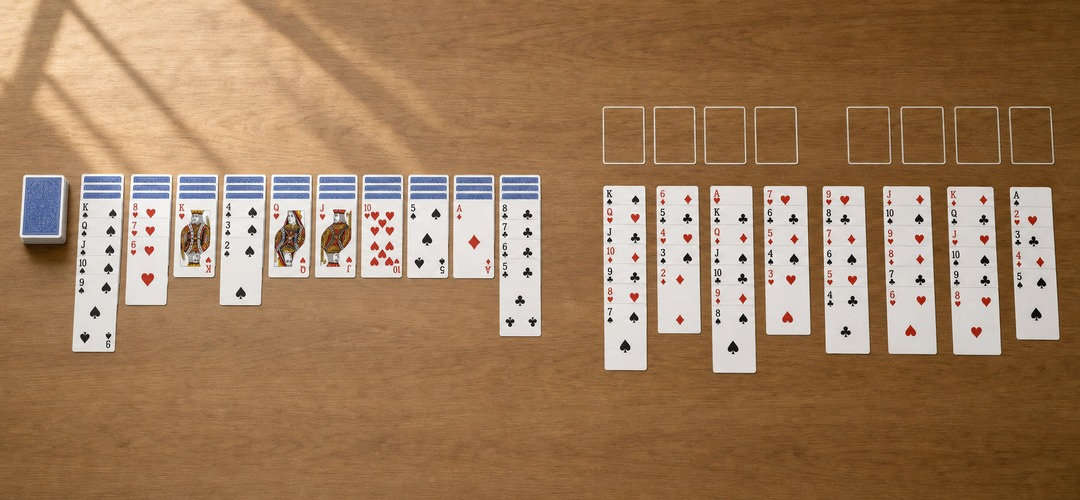
Alaska Solitaire is a challenging variation of Yukon Solitaire that rewards careful planning over luck. The goal is the same as classic Klondike — move all 52 cards to the four foundations — but the way you build sequences is what sets Alaska apart: instead of alternating colors, you arrange tableau cards by the same suit, and you can build either up or down. With no stockpile and the freedom to move buried cards, every move counts.
You can play Alaska Solitaire right here for free — no download and no registration. Because of its strict same-suit sequencing, Alaska is widely considered one of the hardest solitaire games to win, so take your time and use the undo and hint buttons as you learn. When you are ready for a different challenge, explore our full collection of solitaire games.
Alaska Solitaire Rules
The objective of Alaska Solitaire is to move all 52 cards from the tableau into four foundation piles, each built up by suit from Ace to King. Alaska uses a single 52-card deck and has no stockpile or waste pile — everything you need is dealt at the start.
The Objective
Win by building all four foundations from Ace to King, one for each suit. Since every card is in play from the beginning, success depends on the order in which you uncover and rearrange cards, not on the luck of a draw.
Building the Tableau
This is the rule that makes Alaska unique. Tableau cards are sequenced by the same suit, and you may build in either ascending or descending order. For example, a 9 of Diamonds can be placed on top of either the 8 of Diamonds or the 10 of Diamonds. Ranks do not wrap around, so you cannot place an Ace on a King or a King on an Ace.
Moving Groups of Cards
Like all Yukon-style games, Alaska lets you move a group of cards even when they are not in perfect sequence. Any face-up card — even one buried partway down a column — can be moved together with every card stacked on top of it. The only requirement is that the bottom card of the group you are moving fits the destination: it must be the same suit and one rank higher or lower than the card it lands on.
Moving Cards to the Foundations
The four foundations are built up by suit in ascending order. Start each foundation with an Ace, then add the 2, 3, 4 and so on of the same suit until you reach the King. Cards sent to the foundation are out of play, so think before you commit a card you might still need in the tableau.
Empty Tableau Columns
When you clear a column completely, only a King — or a group of cards headed by a King — can be placed into the empty space. Empty columns are one of Alaska's most valuable resources because they give you room to reorganize sequences and free trapped cards.
No Stockpile or Waste Pile
Alaska Solitaire has no stockpile and no waste pile. Every card is dealt to the tableau at the start of the game, which is why planning ahead matters so much. There are no extra cards to bail you out of a difficult position.
Winning the Game
You win when all 52 cards have been moved from the tableau to the four foundation piles, completing each suit from Ace to King.
How to Play Alaska Solitaire
Follow these seven steps to go from the opening deal to a completed game.
Step 1: Understand the Layout
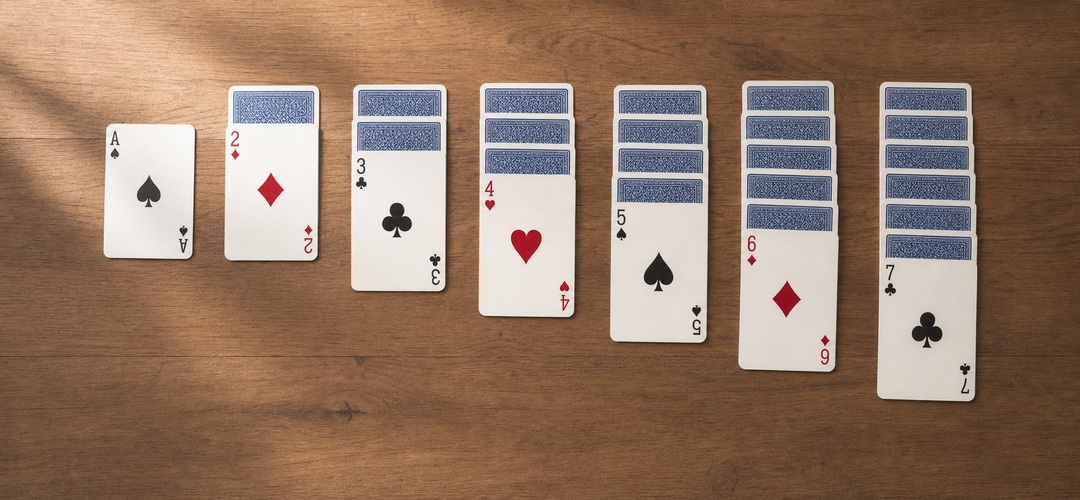
Alaska deals 7 tableau columns. The first column holds a single face-up card. Each following column has a row of face-down cards topped by five face-up cards, so the columns grow longer from left to right. There are no stock or waste piles — what you see is what you have.
Step 2: Reveal Hidden Cards
Your first priority is to expose the face-down cards. Every hidden card you turn over gives you more options, so make moves that unblock the longest face-down rows early.
Step 3: Build Tableau Columns by Suit
Arrange face-up cards by the same suit, building up or down. Because you can go in both directions, you often have more ways to connect cards than in Russian Solitaire — but staying within one suit is far more restrictive than Yukon's alternating colors, so plan each chain carefully.
Step 4: Move Card Groups Strategically
Use Alaska's group-move rule to relocate buried face-up cards along with everything on top of them. Just make sure the bottom card of the group lands on a same-suit card one rank above or below it.
Step 5: Start Building the Foundations
As soon as Aces become available, send them to the foundations and follow with low cards of the same suit. Be careful not to advance a foundation too fast if you still need that card to anchor a tableau sequence.
Step 6: Create Empty Columns
Work to empty a column entirely. An open column lets you reposition a King and the cards beneath it, untangling difficult piles and giving you the flexibility you need to win.
Step 7: Complete All Four Foundations
Keep cycling through the tableau, uncovering cards and building sequences until every suit is completed from Ace to King. When all four foundations are full, you win.
Alaska Solitaire vs Yukon Solitaire
Alaska is a direct variation of Yukon, so they share the same layout, the same group-move rule, and the absence of a stockpile. The difference comes down to how you build the tableau.
| Feature |
Yukon Solitaire |
Alaska Solitaire |
| Tableau building |
Descending, alternating colors |
Same suit, ascending or descending |
| Direction |
Down only |
Up or down |
| Difficulty |
Challenging |
Harder |
| Stockpile |
None |
None |
| Group moves |
Yes |
Yes |
Which game is harder? Alaska is the tougher of the two. Requiring same-suit sequences sharply limits your legal moves compared with Yukon's alternating colors, even though Alaska's two-directional building gives a little flexibility back.
Which one should you play? If you are new to Yukon-style games, start with Yukon Solitaire to learn the group-move mechanic, then move up to Alaska when you want a stiffer test.
Alaska Solitaire vs Russian Solitaire
Alaska and Russian Solitaire are close cousins — both build the tableau by suit rather than by color. The single difference is direction.
| Feature |
Russian Solitaire |
Alaska Solitaire |
| Tableau building |
Same suit, descending only |
Same suit, ascending or descending |
| Flexibility |
Lower |
Slightly higher |
| Difficulty |
Very hard |
Hard |
In Russian Solitaire you may only build down in suit, while Alaska also lets you build up. That extra direction makes Alaska marginally more forgiving, but both belong firmly among the most demanding Yukon variants.
Alaska Solitaire Strategies and Tips
Alaska is a game of skill. These tips will help you win more often.
Clear the Aces as Soon as Possible
Get Aces and low cards onto the foundations early so they stop clogging your columns and free up the cards beneath them.
Focus on Uncovering Face-Down Cards
Prioritize moves that expose hidden cards. Every revealed card widens your options, and Alaska's tight same-suit rule means you need all the choices you can get.
Plan Several Moves Ahead
Because there is no stockpile, a single careless move can lock the game. Look ahead before relocating a long group, and avoid sending a card to the foundation if it still anchors a useful tableau sequence.
Use Empty Columns Wisely
An empty column is precious — reserve it for repositioning a King and its trailing cards so you can untangle blocked piles, rather than filling it on impulse.
Take Advantage of Online Features
Use the undo and hint buttons while you learn the same-suit build. They let you experiment with risky lines and understand why a move helps or hurts before you commit to it.
Alaska Solitaire Variants
If you enjoy Alaska, these related Yukon-family games are worth a try.
Russian Solitaire
The closest relative — built by suit, but in descending order only, making it even more unforgiving. Try Russian Solitaire.
Yukon Solitaire
The original of the family, built down in alternating colors. A great place to master the group-move rule. Play Yukon Solitaire.
Scorpion Solitaire
A related challenge that also lets you move buried cards and builds down by suit, with a small stock to deal at the end. Play Scorpion Solitaire.
Which variant should you try? If Alaska feels comfortable, step up to Russian Solitaire for the ultimate same-suit test, or switch to Yukon for a slightly gentler game.
Alaska Solitaire FAQs
What is Alaska Solitaire?
Alaska Solitaire is a single-player card game and a variation of Yukon Solitaire. You build tableau sequences by the same suit, up or down, and move all 52 cards to four foundations from Ace to King to win.
How is Alaska Solitaire different from Yukon Solitaire?
In Yukon you build the tableau down in alternating colors. In Alaska you build by the same suit and can go either up or down. The same-suit requirement makes Alaska noticeably harder.
Is Alaska Solitaire the same as Russian Solitaire?
They are nearly identical. Both build by suit, but Russian Solitaire only allows descending sequences, while Alaska also lets you build upward. That makes Alaska slightly more flexible than Russian.
Is Alaska Solitaire harder than Klondike?
Yes. Klondike builds in alternating colors and uses a stockpile, while Alaska restricts you to same-suit sequences with no stockpile, so far fewer deals are winnable.
Can every game of Alaska Solitaire be won?
No. Because of the strict same-suit rule and the absence of a stockpile, many deals cannot be solved. A large share of games are winnable with careful play, but not all of them.
Can I move any group of cards in Alaska Solitaire?
Yes. You can move any face-up card together with every card stacked on top of it, even if it is buried in a column, as long as the bottom card of the group fits a same-suit card one rank higher or lower.
Is there a stockpile in Alaska Solitaire?
No. Alaska has no stockpile and no waste pile. All cards are dealt to the tableau at the start, so you must work with what you are given.
When can I move a King in Alaska Solitaire?
A King — alone or at the head of a group — is the only card that can be placed into an empty tableau column. Within a column, a King can also be built on a same-suit Queen.
What is the best strategy for Alaska Solitaire?
Clear Aces early, prioritize uncovering face-down cards, plan several moves ahead because there is no stockpile, and save empty columns for repositioning Kings.
Is Alaska Solitaire a game of luck or skill?
Mostly skill. Since every card is visible from the start and there is no draw pile, your decisions — not chance — determine whether you win.