Solitaire
Classic Card Game
by Appgeneration Software


Yukon Solitaire
Play Yukon Solitaire online for free! Challenge your mind with this classic card game on Solitaire365. Click to stack the cards and win now!
✅ Free · ✅ No sign-up · ✅ No download · ✅ Fullscreen · ✅ Mobile-friendly
About Yukon Solitaire
Yukon Solitaire is a card game inspired by the traditional Klondike Solitaire, but with significant differences. The goal is the same in both cases, with the players having to build the foundations in ascending order. Likewise, the cards on the tableau can only be moved to top others with one rank higher and in alternating colors. However, this is where the similarities end.
In a game of Yukon, there are very specific and unusual rules to move the cards around the tableau. The display of the tableau itself is also different from that of Klondike since all the cards are laid down in the columns and there is no stockpile. This means that, to some extent, Yukon Solitaire can be a much challenging game because once the players get stuck and they cannot find any available moves, they lose the game.
Yukon Solitaire Rules
Understanding the rules of Yukon Solitaire is the key to mastering this challenging and rewarding card game. While Yukon shares some similarities with Classic Solitaire, its unique movement mechanics create a very different experience that requires careful planning and strategy.
The objective of Yukon Solitaire is to move all 52 cards to the four foundation piles. Each foundation must be built upward by suit, starting with the Ace and ending with the King.
Building the Tableau
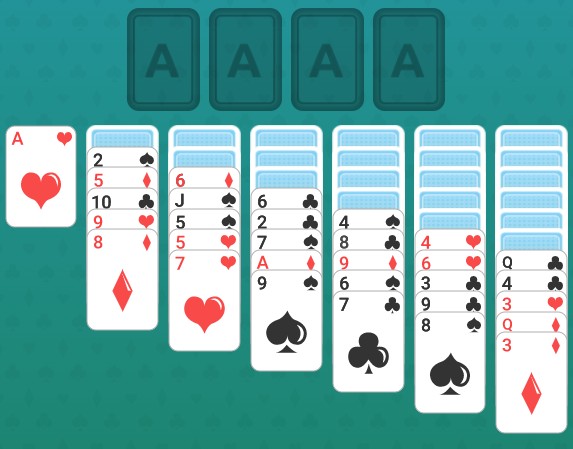
Cards in the tableau are built downward in descending rank and must alternate colors. For example, a black 8 can be placed on a red 9, and a red 7 can be placed on a black 8.
Valid moves include:
- Placing a black 10 on a red Jack.
- Placing a red 6 on a black 7.
- Moving a complete sequence that follows alternating colors.
Moving Groups of Cards
The most distinctive Yukon Solitaire rule is that groups of cards can be moved even when the cards within the group are not arranged in perfect sequence.
As long as the bottom card of the moving group can legally be placed onto another tableau pile, the entire stack may be moved together. This creates opportunities that do not exist in Klondike Solitaire and allows experienced players to reorganize the tableau in powerful ways.
For example, if a red 8 is the bottom card of a stack, the entire stack may be moved onto a black 9, even if some cards above the 8 are not arranged in descending order.
Moving Cards to the Foundations
Foundation piles are built upward by suit:
- Ace → 2 → 3 → 4 → 5 → 6 → 7 → 8 → 9 → 10 → Jack → Queen → King
- All cards in a foundation must belong to the same suit.
Whenever an Ace becomes available, it can be moved to start a foundation pile. Additional cards of the same suit may then be added in ascending order.
Empty Tableau Columns
When a tableau column becomes empty, only a King or a group of cards headed by a King may be moved into that space.
Creating an empty column can be extremely valuable because it gives you more freedom to rearrange cards and uncover hidden cards elsewhere on the tableau.
No Stockpile or Waste Pile
Unlike Klondike Solitaire, Yukon Solitaire does not use a stockpile or waste pile. All cards are dealt onto the tableau at the beginning of the game, and every move must be made using the cards already in play.
Because there are no additional cards to draw, success depends entirely on planning ahead, revealing hidden cards, and making efficient use of tableau spaces.
Winning the Game
You win Yukon Solitaire when all cards have been moved from the tableau to the four foundation piles. A successful game requires balancing immediate opportunities with long-term planning, as moving cards too quickly to the foundations can sometimes block more important tableau moves later in the game.
How to Play Yukon Solitaire
Yukon Solitaire is a challenging variation of Classic Solitaire that rewards careful planning and strategic thinking. The goal is to move all 52 cards to the four foundation piles, building each suit from Ace to King. Unlike Klondike Solitaire, there is no stockpile to draw from, so every move must be made using the cards already visible on the tableau.
Step 1: Understand the Layout
At the start of a Yukon Solitaire game, all cards are dealt into seven tableau columns. Some cards are face down, while many are visible from the beginning. Since there is no stockpile or waste pile, the tableau contains every card you will use throughout the game.
The four foundation piles begin empty and are built upward by suit, starting with the Aces.
Step 2: Reveal Hidden Cards
One of your first priorities should be uncovering face-down cards. Every hidden card limits your available moves, while every revealed card creates new opportunities. Before making a move, consider whether it will help expose additional cards in the tableau.
In many games, revealing hidden cards is more valuable than immediately moving cards to the foundations.
Step 3: Build Tableau Columns in Descending Order
Cards on the tableau are arranged in descending rank and alternating colors. For example:
- A black 8 can be placed on a red 9.
- A red 7 can be placed on a black 8.
- A black Queen can be placed on a red King.
Building long descending sequences helps organize the tableau and creates opportunities to access buried cards.
Step 4: Move Card Groups Strategically
Yukon Solitaire's most unique feature is its flexible movement system. You can move groups of cards even when the cards within the group are not arranged in perfect sequence.
The only requirement is that the bottom card of the moving group must legally fit onto the destination card. This rule allows you to reorganize large portions of the tableau and create moves that would be impossible in many other solitaire games.
Learning when to move entire stacks is one of the most important skills in Yukon Solitaire.
Step 5: Start Building the Foundations
Whenever an Ace becomes available, move it to a foundation pile. Foundations are built upward by suit:
- Ace → 2 → 3 → 4 → 5 → 6 → 7 → 8 → 9 → 10 → Jack → Queen → King
Although foundation building is essential, avoid rushing cards out of the tableau. Sometimes keeping a card in play provides more flexibility for future moves.
Step 6: Create Empty Columns
Clearing a tableau column creates an empty space that can only be filled by a King or a stack beginning with a King. These empty columns are powerful strategic tools because they provide additional room to rearrange cards and unlock new sequences.
Whenever possible, plan moves that help create and effectively use empty tableau spaces.
Step 7: Complete All Four Foundations
Continue revealing hidden cards, reorganizing tableau columns, and building the foundations until every card has been moved to its suit pile. The game is won when all four foundations contain complete sequences from Ace through King.
Successful Yukon Solitaire players think several moves ahead, balancing short-term opportunities with long-term positioning. Careful planning and efficient use of the tableau are often the difference between victory and defeat.
Yukon Solitaire vs Klondike Solitaire
Yukon Solitaire and Klondike Solitaire are two of the most popular single-player card games, but they offer very different gameplay experiences. While both share the same objective—moving all cards to foundation piles—the rules and strategy requirements make Yukon significantly more flexible and more challenging.
Key Differences
| Feature | Yukon Solitaire | Klondike Solitaire |
|---|---|---|
| Stockpile | No stockpile (all cards are dealt at the start) | Uses a stockpile and waste pile |
| Card Movement | Can move groups of cards even if not fully ordered | Only correctly ordered sequences can be moved |
| Hidden Information | Fewer hidden cards, more visible from the start | More face-down cards and hidden progression |
| Difficulty | Generally harder and more strategic | More balanced and beginner-friendly |
Gameplay Style
:contentReference[oaicite:0]{index=0} focuses heavily on strategic planning and long-range thinking. Because you can move partially ordered stacks and there is no stockpile, every decision has a direct impact on the entire tableau.
In contrast, :contentReference[oaicite:1]{index=1} relies more on incremental discovery through the stockpile. This introduces an element of chance, making it more accessible but less deterministic than Yukon.
Which Game Is Harder?
Yukon Solitaire is widely considered more difficult than Klondike Solitaire. The ability to move large groups of cards creates more possibilities—but also more complexity. Players must constantly evaluate multiple layers of potential moves.
Klondike, on the other hand, offers a more structured progression with fewer immediate possibilities, making it easier for casual players but less flexible for advanced strategy.
Which One Should You Play?
If you enjoy deep strategy, long-term planning, and solving complex card arrangements, Yukon Solitaire is the better choice. If you prefer a more relaxed experience with a mix of luck and strategy, Klondike Solitaire is ideal.
Yukon Solitaire strategies and tips
Do not free the columns if there are no kings available
The kings are the only cards that can fill an empty space on the tableau. Unlike other Solitaire games in which empty spaces are an advantage, in Yukon Solitaire you need to think more strategically about them.
If you do not have a king available to fill the space immediately, getting an unoccupied space will only mean that you will have less room to move around the cards. Remember that you can only move a card to top one that is free. This means that you start the game with 7 possible moves. However, for each column you clear without filling it in, you reduce the number of possible moves you can make.
Clear the aces as soon as possible
Aces are the opposite of kings since they can top a 2 but no other card can go on top of them. Having them around on the tableau is not only useless, but it can also hinder the number of possible moves you can make.
The aces are also the building blocks of the foundations. They are the first card you need to send there in order to start building the needed sequences. The quicker you get them out of the way, the easier it will become to progress in the game.
Focus on uncovering the face-down cards
Having all the cards facing up increases immensely your chances of winning. Once you have the tableau fully revealed, it will be much easier and simpler to start building sequences to reach the cards you need for the foundations.
When looking for possible moves, never lose sight of the top card blocking a face-down one.
Plan ahead
For each card there are only two that can top them. For example, a red 7 can only be covered by the two black 6 of the deck.
Imagine that a red seven becomes free and you have the two black 6 available. Instead of randomly moving one, think carefully about the opportunities each will open. For instance, if one of the 6 frees space in the tableau but you do not have a king to fill it, there is no point in moving it. It would be better to leave it there to avoid cluttering the remaining columns to no gain.
Take advantage of the online features
Playing Yukon Solitaire online has many advantages, starting with the fact that you do not need to find a physical space to play it and lose time setting the tableau for each new game.
Another plus of online Yukon Solitaire games is that you can conveniently use a strategy of trial and error. When in doubt about which route to pursue, you can try one out and then simply undo the movements to try the others. In the end, you can just choose the one most profitable.
Although one can argue that it is also possible to do this when playing with real cards, it is undoubtedly more complicated to keep shifting the cards around, not to mention remembering the path one took to be able to revert the game if needed.
Yukon Solitaire Variants
Yukon Solitaire has inspired several popular variations that modify its rules, difficulty, or layout. These variants keep the core mechanics of Yukon—such as moving groups of cards and playing without a stockpile—but introduce small changes that create new strategic challenges.
Russian Solitaire
Russian Solitaire is one of the closest relatives of Yukon. It follows similar tableau-building rules, but increases difficulty by requiring cards to be placed in suit order rather than alternating colors. This makes planning significantly more restrictive and strategic.
Alaska Solitaire
Alaska Solitaire is a more flexible variation of Russian Solitaire. It allows both ascending and descending sequences regardless of suit color, giving players more movement options while still maintaining a high level of difficulty.
Double Yukon Solitaire
Double Yukon uses two full decks of cards instead of one, significantly increasing the complexity of the game. The larger tableau requires more advanced planning, as players must manage a much higher number of possible sequences and moves.
Triple Yukon Solitaire
Triple Yukon is an even more complex variant that uses three decks of cards. It is considered a very advanced version of Yukon Solitaire and is typically played by experienced players looking for a long and highly strategic game.
Scorpion Solitaire (Related Variant)
Although not a direct Yukon variant, Scorpion Solitaire shares similar mechanics, including tableau manipulation and sequence building. However, it introduces its own unique rules, such as partially face-up columns and stricter movement constraints.
Which Variant Should You Try?
If you are new to Yukon Solitaire, the classic version is the best starting point. Once you are comfortable with its mechanics, Russian or Alaska Solitaire are good next steps. For players looking for a serious challenge, Double or Triple Yukon offer significantly more depth and complexity.
Yukon Solitaire FAQs
Is Yukon Solitaire harder than Klondike?
Yes. Yukon Solitaire is generally considered harder than Klondike because there is no stockpile, and players must rely entirely on the initial layout. In addition, the ability to move partially ordered groups increases complexity and requires deeper strategic planning.
Can every game of Yukon Solitaire be won?
No. Not every Yukon Solitaire deal is solvable. Like most solitaire variants, the outcome depends on the initial shuffle. However, skilled players can significantly improve their win rate by making optimal decisions early in the game.
What makes Yukon Solitaire different from other solitaire games?
The main difference is that Yukon Solitaire allows you to move groups of cards even if they are not perfectly ordered. Combined with the absence of a stockpile, this creates a more open and strategic gameplay experience compared to many other solitaire variants.
Can I move any group of cards in Yukon Solitaire?
You can move a group of cards as long as the bottom card of the group can be legally placed onto another tableau card following alternating color and descending order rules. The internal order of the group does not need to be perfect.
Is there a stockpile in Yukon Solitaire?
No. Yukon Solitaire does not use a stockpile or waste pile. All cards are dealt at the beginning of the game, and every move must be made using the cards visible on the tableau.
What is the best strategy for Yukon Solitaire?
A strong strategy is to prioritize revealing hidden cards, avoid unnecessary moves to the foundations too early, and use empty columns strategically to reorganize the tableau. Planning several moves ahead is essential for success.
When can I move a King in Yukon Solitaire?
Kings can only be moved into empty tableau columns. Creating space for Kings is important because it allows you to reposition large sequences and unlock blocked areas of the tableau.
Are there different versions of Yukon Solitaire?
Yes. Popular variants include Russian Solitaire, Alaska Solitaire, and multi-deck versions such as Double and Triple Yukon. These variations adjust difficulty and movement rules while keeping the core gameplay similar.
Is Yukon Solitaire a game of luck or skill?
Yukon Solitaire is primarily a game of skill, although the initial deal introduces some randomness. Most of the outcome depends on how well you plan moves, manage tableau space, and reveal hidden cards.
Check our latest articles

Hardest Solitaire Games: 21 Challenging Variants Ranked
The hardest solitaire games are not always the ones with the most complicated rules. Some are difficult because they give you very few recovery options. Others are hard because they require long-term planning, strict suit-building, careful stock management or a good deal of patience when the cards do not cooperate.…

Advanced FreeCell Strategy: How to Win (Almost) Every Single Game
Have you ever stared at a FreeCell board, completely blocked, wondering if the game was rigged? It’s a frustrating feeling, but here is a mind-blowing fact to kickstart your confidence: in the original Windows 95 version of FreeCell, out of 32,000 numbered deals, only one single game was proven to…
Spider Solitaire vs FreeCell: Which Game Should You Play?
Spider Solitaire and FreeCell Solitaire are two of the most strategic solitaire games, but they feel very different once you start playing. Spider Solitaire is a longer sequencing game with two decks, 10 tableau columns, hidden cards, and difficulty levels based on suits. FreeCell is a more open logic puzzle…
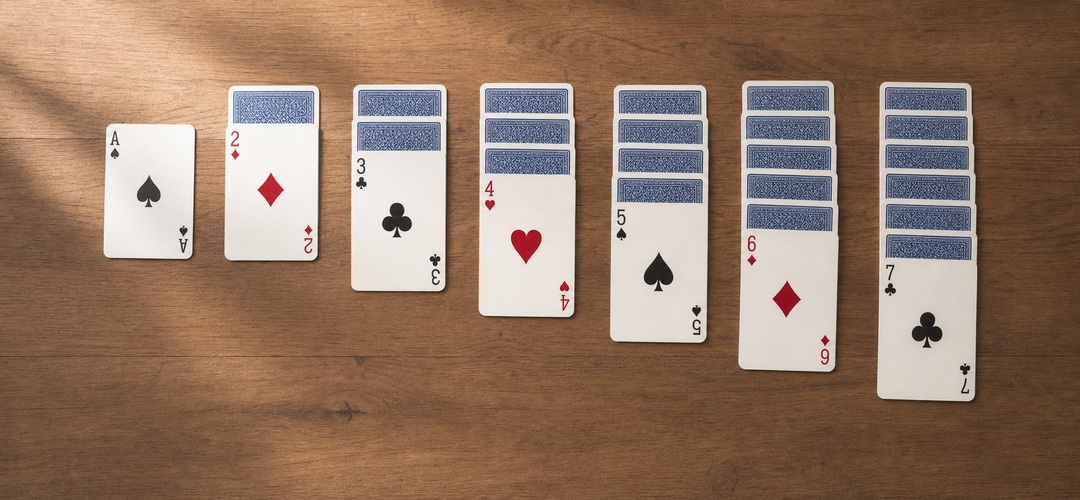
How Many Rows Are in Solitaire? Layout Guide
Classic Solitaire, also called Klondike, has seven tableau columns. Many beginners ask how many rows in Solitaire because the cards appear to spread across the table, but the correct term is usually columns. The first column has 1 card, the second has 2 cards, and the pattern continues until the…