Solitaire
Classic Card Game
by Appgeneration Software


Scorpion Solitaire
Play Scorpion Solitaire free online! Challenge your mind with this exciting, fast-paced card game. No downloads required—just click and start playing now!
✅ Free · ✅ No sign-up · ✅ No download · ✅ Mobile-friendly · ✅ Fullscreen
About Scorpion Solitaire
Scorpion Solitaire is a card game inspired by Spider Solitaire. Interestingly enough, they only share two rules: you have to build a complete sequence on the tableau before sending it to the foundations and you can only create sequences in descending order. Everything else is different and designed to make this card game much tougher. So much so, that on average, players only win approximately 5% of the games they play.
The low odds give this game a special appeal. This percentage does not represent the winnable games (games with at least one possible solution). It showcases the difficulty of Scorpion Solitaire and works as a motivator to improve one's strategies.
Scorpion Solitaire rules and tableau
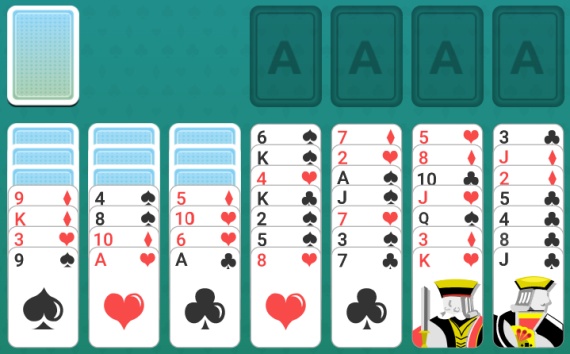
Scorpion Solitaire uses a standard 52-card deck. Out of these, three are removed and placed face down on the tableau to serve as the stockpile. The remaining cards are set on the tableau to form 7 columns with 7 cards each. All the cards are facing up, except on the first three columns starting from the left which have the three cards furthest from the player face down. In this online Scorpion Solitaire, the tableau will be set automatically at each new game.
The goal of the game is to build the 4 foundations by suit. Similar to Solitaire Spider, only complete sequences can be sent to the foundations, not single cards.
The sequences must be built on the tableau in descending order (starting with the King and ending with the Ace), and by suit.
How to play Scorpion Solitaire
To create the needed sequences on the tableau, the players have to shift the cards between the columns. It is possible to move any card face up on the tableau, regardless of its position within the column. However, a card can only be moved to top a free one (no other card on top of it) and that is one rank higher and from the same suit. If the card being moved has others on top of it, they will follow to the new position.
For example, if you have a free 2 and an Ace in another column topped by a 6 and a 7, these last two will accompany the Ace when you move it to the 2.
Empty spaces on the tableau can only be filled with Kings. A complete sequence can only be moved to the foundations if the King is the first card on the top of the column. This means that the Kings will always have to fill an empty space unless they already start in that position at the beginning of the game.
The stockpile is one-use only. It will add the three cards to the first three columns on the left of the tableau.
Tips to win at Scorpion Solitaire
Check if the game is winnable
To avoid losing time, start by analyzing the cards on the tableau to check if there is a sequence of cards that would make it impossible to win the game.
For example, if you see the 7 of spades directly covered by the 5 and the 6 of spades in this order, you know that the game is not winnable. To move the 6 to the 7 you would need to get rid of the 5 in between, but this could only go on top of the 6 that it is covering it.
Focus on turning up the cards facing down
Getting all the cards face-up on the tableau will significantly increase your chances of winning. It will give you a better perception of the moves you have available as well as if the game is winnable or not.
Some players also prefer to use the stockpile from the beginning to avoid any sense of uncertainty throughout the game. Others prefer to avoid using it until the very end to avoid cluttering the columns. Choosing one way or the other depends solely on your style of playing.
Delay filling the empty spaces
In Scorpion Solitaire, empty spaces can only be filled with Kings, but sending them there has its pitfalls. Once you get a free space, check to see if moving any of the Kings you have available might unlock other moves and how many. Always choose the one that opens up more options.
However, even then, you should delay moving that King until you have no more movements left. For example, you never know if in the following moves you will turn a card face down and discover a King there blocking that column.
Avoid exposing the Aces
No card can be placed on top of an Ace, so freeing it is not going to help progress in the game. They are always an inconvenience whichever their position, but if you expose one at the end of a column you will be effectively locking that column.
Exposing an Ace will be unavoidable at some point, but try to delay it as much as possible so that you have more options to shift the cards around.
Scorpion Solitaire vs Other Solitaire Games
Scorpion Solitaire sits in an unusual place within the solitaire family. It shares its goal structure with Spider Solitaire, its card movement mechanics with Yukon, and its single-deck format with Klondike — yet it plays quite differently from all three. Here is how they compare across the rules that matter most.
| Scorpion | Spider | Yukon | Klondike | |
|---|---|---|---|---|
| Decks | 1 (52 cards) | 2 (104 cards) | 1 (52 cards) | 1 (52 cards) |
| Tableau columns | 7 | 10 | 7 | 7 |
| Sequence building | Same suit, descending | Same suit, descending | Alternating colors, descending | Alternating colors, descending |
| Moving groups of cards | Any face-up card and all cards beneath it | Only fully sequenced groups | Any face-up card and all cards beneath it | Only fully sequenced groups |
| Stockpile | 3 cards, used once | Deals 1 card to every column, multiple times | None | 24 cards, drawn 1 or 3 at a time |
| Empty column rule | Kings only | Kings only | Kings only (most versions) | Kings only |
| Foundations | Built in tableau, sent automatically | Built in tableau, sent automatically | Built one card at a time | Built one card at a time |
| Win rate | ~5% | ~25% (1 suit) to ~1% (4 suits) | ~14% | ~33% (draw 1) / ~11% (draw 3) |
| Difficulty | Very hard | Medium to very hard | Hard | Easy to medium |
Scorpion vs Spider Solitaire
Spider is the game Scorpion is most often compared to, and for good reason — both require you to build complete King-to-Ace sequences of the same suit directly on the tableau before they are cleared to the foundations. The key difference is in how cards can be moved. In Spider, you can only pick up a group of cards if they form a proper, unbroken sequence. In Scorpion, you can move any face-up card along with everything beneath it, regardless of order — but the card you are placing it onto must be the same suit and one rank higher. Spider also uses two full decks across ten columns, making it a longer game with more cards to manage, and its stockpile deals one card to every column each time it is used. Scorpion's reserve is a one-shot deal of just 3 cards.
Scorpion vs Yukon Solitaire
Yukon is where Scorpion gets its movement mechanic. Both games let you grab any face-up card and drag all the cards beneath it to a new column, even if those cards are not in sequence. The critical difference is the suit rule: Yukon builds sequences in alternating colors (red on black, black on red), while Scorpion requires the same suit throughout. This makes Scorpion considerably harder, since you have far fewer valid destinations for any given card. Yukon also has no stockpile at all — every card is on the table from the start — while Scorpion holds 3 cards in reserve.
Scorpion vs Klondike Solitaire
Klondike is the version most people think of as "Solitaire." It is also the most forgiving of the four: sequences are built in alternating colors (not by suit), the stockpile can be drawn from repeatedly, and foundations are built one card at a time rather than requiring a full King-to-Ace run in the tableau first. In Scorpion, you cannot send a single card to the foundation — you must complete the entire sequence on the tableau before it is cleared. That single rule raises the strategic demands considerably, and it is a large part of why Scorpion's win rate (~5%) is so much lower than Klondike's (~33% on draw-1 mode).
Which game should you play?
If you are new to solitaire, start with Klondike. If you enjoy Klondike and want a greater challenge, Yukon or Spider (1 suit) are natural next steps. Scorpion is best approached once you are comfortable with suit-based building and long-term planning — it rewards patience, pattern recognition, and the ability to spot deadlocks early. The low win rate is not a reason to avoid it; it is the point.
Frequently Asked Questions
What is Scorpion Solitaire?
Scorpion Solitaire is a card game inspired by Spider Solitaire, but with its own distinct rules that make it considerably harder. The goal is to build 4 complete foundations — one per suit — in descending order from King to Ace, entirely within the tableau before they are sent to the foundations.
How do you play Scorpion Solitaire?
Any face-up card on the tableau can be moved, regardless of its position within the column. A card can only be placed on top of a free card (with no other card on top of it) that is one rank higher and from the same suit. Any cards sitting on top of the card being moved will follow it to its new position. Empty spaces can only be filled with Kings, and a complete King-to-Ace sequence of the same suit is automatically sent to the foundations.
How is the tableau set up in Scorpion Solitaire?
The game uses a standard 52-card deck. Three cards are set aside face down as the stockpile. The remaining 49 cards are dealt into 7 columns of 7 cards each. In the three leftmost columns, the three cards furthest from the player start face down. All other cards are face up from the beginning. In the online version at Solitaire 365, the tableau is set up automatically at the start of each new game.
What is the win rate for Scorpion Solitaire?
On average, players win approximately 5% of the games they play, making Scorpion Solitaire one of the most challenging solitaire variants available. This low rate reflects the difficulty of the game rather than the proportion of winnable deals — it serves as a motivator to sharpen your strategy and improve over time.
Is Scorpion Solitaire always winnable?
Not every deal is solvable. Roughly 80% of Scorpion Solitaire games have at least one possible solution, but some hands are unwinnable from the very start. That is why it is worth checking for deadlocks early — for example, if three cards of the same suit appear in an order that makes sequencing impossible (such as a 7 directly covered by a 5 and a 6 of the same suit), the game cannot be completed.
What is the difference between Scorpion Solitaire and Spider Solitaire?
Both games require building complete descending sequences of the same suit before sending them to the foundations. Beyond that, they differ considerably. In Spider, you can only move a group of cards if they form a proper sequence; in Scorpion, you can move any face-up card and all cards beneath it, regardless of order — but the target must always be the same suit. Spider also uses two decks and deals one card to every column from the stock, while Scorpion uses one deck and deals only 3 cards from the reserve to the leftmost columns.
What is the difference between Scorpion Solitaire and Yukon Solitaire?
Both games allow you to move any group of face-up cards regardless of whether they form a proper sequence. The main differences are in suit rules and stock: in Yukon, tableau sequences are built in descending order alternating colors, while Scorpion requires the same suit throughout. Scorpion also has a small stockpile of 3 cards, whereas Yukon deals all cards at the start with no reserve.
How does the stockpile work in Scorpion Solitaire?
The stockpile holds the 3 cards set aside at the start of the game. It can only be used once: when activated, it deals one card face up to each of the three leftmost columns on the tableau. Some players prefer to use it early to reduce uncertainty; others save it as a last resort to avoid cluttering the columns. Neither approach is strictly better — it comes down to your preferred playing style.
What should I prioritize at the start of a game?
Start by scanning the full tableau to check whether the game is winnable before making any moves. Then focus on turning the face-down cards in the four leftmost columns face up as quickly as possible — this gives you a much clearer picture of the available moves. Avoid using the stockpile until you run out of other options, and hold off on filling empty columns with Kings until you have no better move available.
Why should I avoid exposing Aces?
No card can ever be placed on top of an Ace, so leaving one at the playable end of a column effectively locks it — no further cards can be added. Exposing an Ace is unavoidable at some point, but delaying it as long as possible gives you more room to maneuver the other cards before that column becomes blocked.
How should I handle empty columns in Scorpion Solitaire?
Empty columns can only be filled with Kings. When a space opens up, resist the urge to fill it immediately. First check which available King, once moved, would unlock the most cards or sequences — then choose that one. Even then, wait until you have no other moves left, since the next turn might reveal a King already on the tableau in a better position.
How do I know if a game of Scorpion Solitaire is unwinnable?
Look for circular deadlocks — situations where cards of the same suit are arranged in a way that makes it impossible to build the required sequence. A classic example: if the 7 of spades is directly covered by the 5 and then the 6 of spades, you can never move the 6 onto the 7 because the 5 is blocking it, and the 5 can only go on the 6 that is trapping it. Spotting these early saves you from wasting time on an unwinnable hand.
Are there different variations of Scorpion Solitaire?
Yes. The most well-known variants include Scorpion II, which reverses the face-down card layout and is slightly easier; Wasp, which is identical to Scorpion except that any card (not just Kings) can fill an empty column; and Three Blind Mice, played with 10 columns of 5 cards instead of the usual 7 columns of 7.
Where does Scorpion Solitaire come from?
Scorpion Solitaire first appeared in print in "The Complete Book of Solitaire & Patience Games," published in 1949. Its gameplay combines elements of Spider Solitaire and Yukon Solitaire, and it is believed to have originated around the same era as those two games.
Is Scorpion Solitaire free to play online?
Yes. Scorpion Solitaire is completely free to play at Solitaire 365 — no download, no app, and no registration required. The game runs directly in your browser and is playable on both desktop and mobile devices.
Check our latest articles

Hardest Solitaire Games: 21 Challenging Variants Ranked
The hardest solitaire games are not always the ones with the most complicated rules. Some are difficult because they give you very few recovery options. Others are hard because they require long-term planning, strict suit-building, careful stock management or a good deal of patience when the cards do not cooperate.…

Advanced FreeCell Strategy: How to Win (Almost) Every Single Game
Have you ever stared at a FreeCell board, completely blocked, wondering if the game was rigged? It’s a frustrating feeling, but here is a mind-blowing fact to kickstart your confidence: in the original Windows 95 version of FreeCell, out of 32,000 numbered deals, only one single game was proven to…
Spider Solitaire vs FreeCell: Which Game Should You Play?
Spider Solitaire and FreeCell Solitaire are two of the most strategic solitaire games, but they feel very different once you start playing. Spider Solitaire is a longer sequencing game with two decks, 10 tableau columns, hidden cards, and difficulty levels based on suits. FreeCell is a more open logic puzzle…
How Many Rows Are in Solitaire? Layout Guide
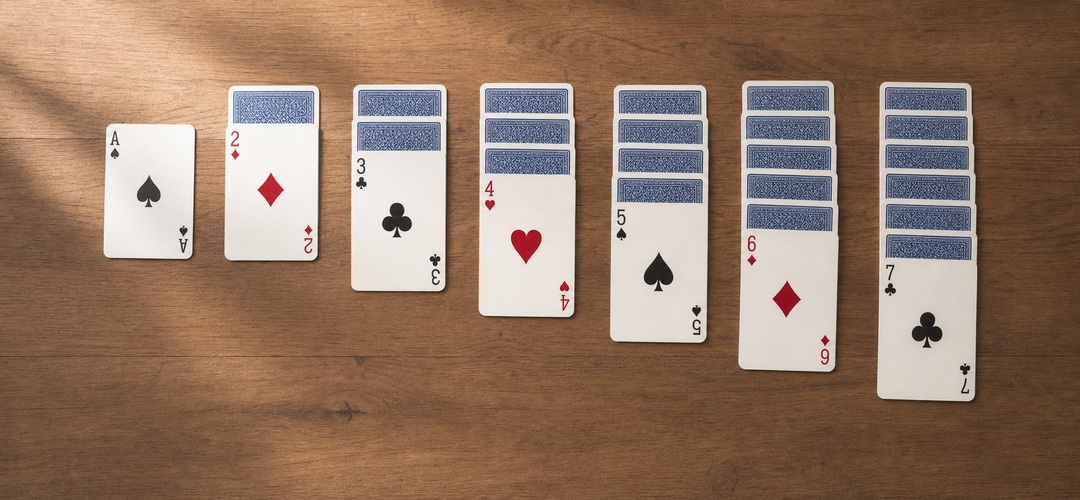
Classic Solitaire, also called Klondike, has seven tableau columns. Many beginners ask how many rows in Solitaire because the cards appear to spread across the table, but the correct term is usually columns. The first column has 1 card, the second has 2 cards, and the pattern continues until the…