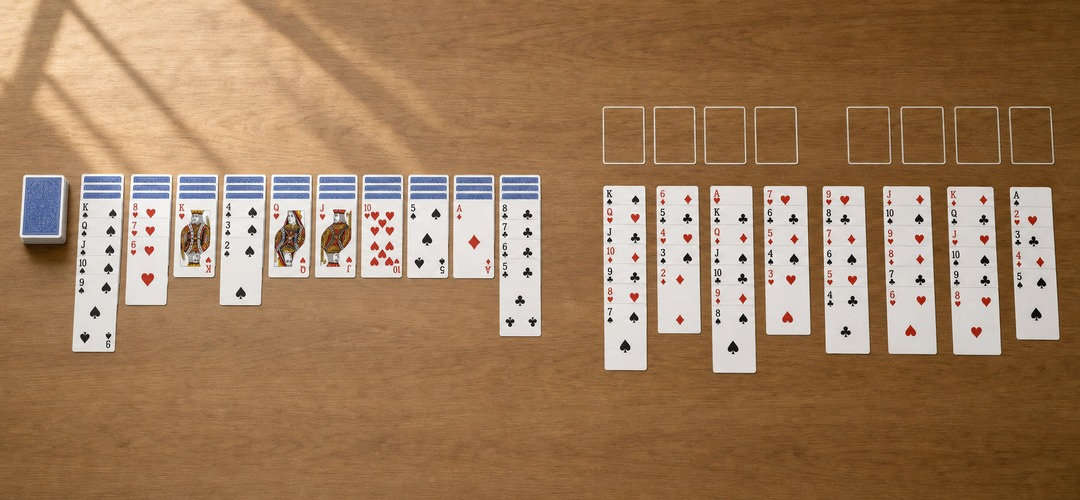
Spider Solitaire is one of the most popular solitaire card games because it combines simple rules with deep strategy. The goal is to arrange cards in descending order from King to Ace, complete full same-suit sequences, and remove all cards from the table.
If you are new to the game, Spider Solitaire can look difficult at first. There are ten columns, many face-down cards, and several ways to move cards around. But once you understand the setup, the rules, and the basic strategy, each game becomes much easier to read.
In this guide, you will learn how to play Spider Solitaire step by step, how the cards are set up, what moves are allowed, how the different difficulty levels work, and which tips can help you win more often.
Quick answer: how do you play Spider Solitaire?
To play Spider Solitaire, arrange cards in descending order from King to Ace in the tableau. You can place a card on another card that is one rank higher. Complete a full sequence from King to Ace in the same suit to remove it from the game. Win by removing all eight sequences.
A standard game uses two full decks, for a total of 104 cards. Cards are dealt into ten tableau columns, with only the top card of each column face up. The remaining cards form the stock, which deals a new row of cards when you run out of useful moves.
You can play Spider Solitaire online and practice the rules directly in your browser.
Spider Solitaire setup
Spider Solitaire is usually played with two standard 52-card decks. That means the game uses 104 cards in total. Unlike Klondike Solitaire, Spider does not use foundation piles that you build from Ace to King. Instead, completed sequences are built directly in the tableau and removed once they run from King down to Ace in the same suit.
At the start of the game:
- Ten tableau columns are dealt.
- The first four columns receive six cards each.
- The remaining six columns receive five cards each.
- Only the top card of each column is face up.
- The remaining cards stay in the stock.
The tableau is where almost all of the game happens. Your job is to reveal face-down cards, organize cards into descending sequences, and create empty columns that give you more room to move.
The goal of Spider Solitaire
The goal of Spider Solitaire is to remove every card from the tableau. To do that, you must build complete sequences from King to Ace in the same suit.
A complete sequence looks like this:
King, Queen, Jack, 10, 9, 8, 7, 6, 5, 4, 3, 2, Ace
When a full same-suit sequence is completed, it is automatically removed from the table. Since Spider Solitaire uses two decks, you need to complete and remove eight full sequences to win the game.
Spider Solitaire rules
The basic rules of Spider Solitaire are easy to learn:
- You can move a face-up card onto another card that is one rank higher.
- You can build descending sequences in the tableau.
- Same-suit sequences are stronger because they can be moved together.
- When a face-down card becomes uncovered, it turns face up.
- Empty columns can be used as temporary spaces.
- When you have no useful moves, you can deal a new row from the stock.
- A new stock row places one card on each tableau column.
- In most versions, you cannot deal from the stock if any tableau column is empty.
The most important rule to remember is this: mixed-suit sequences can help you organize the board, but same-suit sequences are what you need to complete and remove cards.
How to move cards in Spider Solitaire
You can move a card onto a card that is exactly one rank higher. For example, a 9 can be placed on a 10, a Jack can be placed on a Queen, and a Queen can be placed on a King.
In easier versions of Spider Solitaire, the suits may matter less while you are building. However, to move a full sequence together and eventually clear it from the board, the sequence normally needs to be in the same suit.
Here is a simple example:
| Move | Is it allowed? | Why |
|---|---|---|
| 8 on 9 | Yes | The 9 is one rank higher |
| Queen on King | Yes | The King is one rank higher |
| 5 on 7 | No | The ranks are not consecutive |
| 10 on 9 | No | Cards must build downward |
| Same-suit King to Ace sequence | Yes | It can be completed and removed |
Good Spider Solitaire play is not just about making every available move. It is about making the moves that reveal hidden cards, create empty columns, and keep same-suit sequences together.
Spider Solitaire difficulty levels
Spider Solitaire is commonly played in three difficulty levels: 1 suit, 2 suits, and 4 suits. The rules are similar, but the challenge changes a lot.
| Difficulty | Best for | What changes |
|---|---|---|
| 1-suit Spider Solitaire | Beginners | All cards use the same suit, so sequences are easier to build |
| 2-suit Spider Solitaire | Intermediate players | Two suits make planning more important |
| 4-suit Spider Solitaire | Advanced players | All four suits are used, making the game much harder |
If you are learning how to play Spider Solitaire, start with 1 suit. It teaches the structure of the game without overwhelming you. Once you understand how to reveal cards and manage empty columns, move to 2 suits. The 4-suit version is best when you already feel confident with Spider strategy.
How to deal new cards from the stock
When you run out of useful moves, you can deal a new row from the stock. This adds one new face-up card to each tableau column.
Dealing from the stock can help you find new moves, but it also makes the board more crowded. If you deal too early, you may bury important cards and make sequences harder to organize.
Before dealing a new row, try to:
- Reveal any face-down cards you can.
- Move same-suit cards together.
- Create or preserve an empty column.
- Check whether a sequence can be improved.
- Avoid blocking a column with a random card.
As a rule of thumb, deal from the stock only when your current board has no productive moves left.
Why empty columns are so important
Empty columns are one of the most powerful tools in Spider Solitaire. When a column is empty, you can use it as a temporary workspace to rearrange cards and unlock blocked sequences.
An empty column lets you move cards out of the way, rebuild broken sequences, and create longer same-suit runs. It also gives you more control before dealing a new row from the stock.
That is why many strong players focus on opening a column early. Even if the first empty column is messy, it often creates the space you need to turn a difficult game around.
Beginner strategy for Spider Solitaire
Reveal face-down cards as early as possible
Face-down cards are your biggest source of uncertainty. Every time you reveal one, you get more information and more possible moves. Prioritize moves that uncover hidden cards, especially in columns with many face-down cards.
Build same-suit sequences whenever you can
You can sometimes build mixed-suit sequences, but they are harder to move later. Same-suit sequences are more flexible and can eventually be cleared from the table. Whenever two moves look similar, choose the one that keeps cards in the same suit.
Do not deal new cards too soon
The stock can help, but it can also make the tableau harder to manage. Before dealing, scan every column and look for moves that reveal cards or improve your sequences. A single extra move before dealing can make a big difference.
Use empty columns carefully
An empty column is valuable. Do not fill it with the first card you see unless that move helps you reveal a card, build a sequence, or create another empty column. Try to use empty columns as flexible workspaces.
Focus on one or two suits at a time
In 2-suit and 4-suit Spider Solitaire, it is easy to spread your attention across too many columns. Instead, look for areas where one suit is already partly organized. Building around those cards can help you complete your first sequence faster.
Common Spider Solitaire mistakes
Many beginners lose Spider Solitaire because they make moves too quickly. The game rewards patience and planning.
Avoid these common mistakes:
- Moving cards just because a move is available.
- Mixing suits when a same-suit move is possible.
- Dealing from the stock before checking the whole board.
- Filling an empty column with a card that does not help.
- Ignoring columns with many face-down cards.
- Breaking a useful same-suit sequence without a clear reason.
The best move is not always the most obvious move. Before you move a card, ask what the move reveals, what it blocks, and whether it helps you build toward a complete King-to-Ace sequence.
Is Spider Solitaire harder than regular Solitaire?
Spider Solitaire is usually harder than classic Klondike Solitaire, especially in the 2-suit and 4-suit versions. Classic Solitaire often depends on managing the stock and foundations, while Spider Solitaire focuses more on tableau control, long sequences, and empty-column management.
That does not mean Spider Solitaire is only for experts. The 1-suit version is beginner-friendly and a great way to learn the game. As your skill improves, you can increase the difficulty and try more complex layouts.
If you enjoy strategic solitaire games, you may also like FreeCell Solitaire, where all cards are visible from the start and every move depends on planning.
How to win Spider Solitaire more often
Winning Spider Solitaire takes practice, but a few habits can improve your results quickly:
- Reveal hidden cards before making cosmetic moves.
- Keep same-suit cards together whenever possible.
- Try to create at least one empty column early.
- Use empty columns to reorganize difficult sequences.
- Delay stock deals until you have used the board well.
- Avoid breaking clean sequences unless it creates a clear advantage.
- Think two or three moves ahead before moving key cards.
Spider Solitaire is a game of space management. The more room you create, the more options you have. The more options you have, the easier it becomes to complete full sequences.
Practice Spider Solitaire online
The best way to learn Spider Solitaire is to play a few games and apply the rules as you go. Start with the 1-suit version, focus on revealing face-down cards, and pay attention to how empty columns change the game.
You can play Spider Solitaire online for free on Solitaire 365. If you want a fresh challenge every day, try the Daily Solitaire Challenge. You can also browse the full solitaire games collection to discover other card games.