Tripeaks Solitaire is a fast card-clearing solitaire game built around three overlapping peaks. If you want to learn how to play Tripeaks Solitaire, start with the basic idea: remove open cards from the tableau by playing cards that are one rank higher or one rank lower than the current waste card.
Unlike classic Solitaire, where you build foundations by suit, Tripeaks is about creating sequences. A 7 can be followed by a 6 or an 8, then that card becomes the new waste card and the chain can continue. Suits and colors do not matter, which makes the rules easy to learn but the decisions surprisingly strategic.
The game is also written as Tri Peaks Solitaire or Tri-Peaks Solitaire. The names refer to the same idea: a tableau shaped like three small pyramids. You can play a full game of Tripeaks Solitaire once you understand the layout, the open-card rule and how to use the stockpile wisely.
Tripeaks Solitaire setup
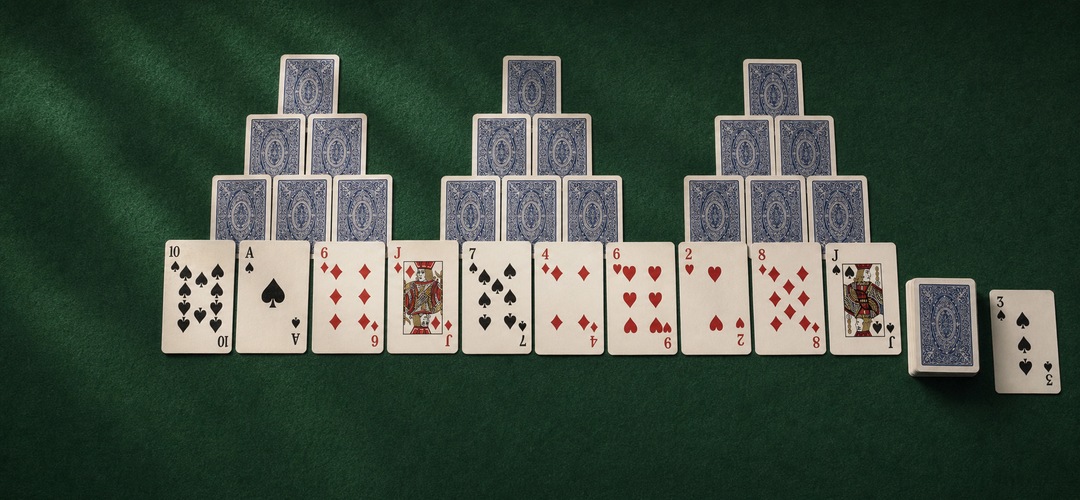
Tripeaks Solitaire uses a standard 52-card deck with no jokers. The tableau contains 28 cards arranged into three overlapping peaks. The remaining cards form the stockpile, and one card is usually turned over to begin the waste pile.
The three peaks are built in four rows. The top row has three cards, one at the top of each peak. The second row has six cards. The third row has nine cards. The bottom row has ten cards, and these are the cards that are open at the beginning of the game.
Here is the basic setup:
| Area | Starting position | What it does |
|---|---|---|
| Tableau | 28 cards in three peaks | The cards you need to clear |
| Open row | 10 face-up cards at the bottom | The first cards available to play |
| Stockpile | Remaining cards face down | Used when no tableau move is available |
| Waste pile | One face-up card | The card you build up or down from |
Only uncovered cards can be played. At the start, that normally means the bottom row of the peaks. When you remove cards from the bottom row, you uncover cards above them. Those newly uncovered cards can then become playable.
Tripeaks Solitaire rules
The main Tripeaks Solitaire rule is simple: you can move an open tableau card onto the waste pile if it is one rank higher or one rank lower than the waste card. If the waste card is a 9, you can play an 8 or a 10. If the waste card is a Queen, you can play a Jack or a King.
Suits do not matter in Tripeaks. A 6 of hearts can be played on a 7 of clubs, and a 10 of spades can be played on a Jack of diamonds. You are only matching by rank, not by color or suit.
A card is open when no other card is covering it. If a face-down card is still partly blocked by cards below it, you cannot use it yet. Once all cards covering it are removed, it is revealed and may become playable.
When you cannot play any open tableau card, draw one card from the stockpile. That card becomes the new waste card. You then look again for open tableau cards that are one rank higher or lower.
Some versions allow wrapping between King and Ace, which means you can play Ace on King or King on Ace. Other versions do not allow this. Before you plan around that move, check the rules of the version you are playing.
Winning and Losing in Tripeaks Solitaire
You win Tripeaks Solitaire by clearing every card from the three peaks. You do not need to use every card in the stockpile. If the tableau is empty, the game is won even if stock cards are still left.
You lose when there are still cards in the peaks, no open tableau card can be played on the waste card, and the stockpile has run out. In other words, the stockpile is your backup plan, but it is limited. That is why good Tripeaks strategy often starts with using every useful tableau move before drawing a new stock card.
Some versions also track score, streaks, remaining stock cards or number of moves. These scoring systems can change what counts as a strong win, but the basic win condition stays the same: clear all three peaks.
How to play Tripeaks Solitaire step by step
Start by looking at the waste card. This card controls your next move. If the waste card is a 5, you are looking for an open 4 or 6 in the tableau.
Next, scan the open cards at the bottom of the peaks. Choose a card that is one rank higher or lower than the waste card. Move that card to the waste pile. It now becomes the new card you play from.
Continue the sequence for as long as possible. If you play a 6 on a 5, you can then play a 7 or 5. If you play a 7, you can then play an 8 or 6. Strong Tripeaks play often comes from building long chains without drawing from the stockpile.
As you remove open cards, you reveal blocked cards above them. Turn those cards face up once they are no longer covered. Then check whether they can continue the sequence.
If no open card can be played, draw one card from the stockpile. Do not draw too early. Every stock card you use reduces your safety net later in the game.
Keep repeating this process until you clear all three peaks or run out of useful moves. The more cards you reveal before using the stockpile, the better your chances usually become.
Example of a Tripeaks move
Imagine the waste card is a 7. The open tableau cards include a 6, an 8 and a Queen. The Queen cannot be played because it is not one rank higher or lower than 7. The 6 and 8 are both legal moves.
Now the choice becomes strategic. If the 6 reveals nothing useful but the 8 uncovers a hidden 9, playing the 8 may be better. After playing 8, the 9 could continue the chain, and that may reveal another card.
This is the heart of Tripeaks strategy. The best legal move is not always the first legal move you notice. Before you play, look at what each move uncovers and whether it can create a longer sequence.
Tripeaks strategy: how to make better decisions
The first strategy is to reveal hidden cards early. Hidden cards reduce your options because you cannot plan around them. Moves that uncover new cards are usually more valuable than moves that only remove a card from the bottom row.
The second strategy is to protect the stockpile. Drawing from the stock feels harmless, but every draw changes the waste card and removes one future chance. If you still have a tableau move available, usually play it before drawing.
The third strategy is to think in chains. A move is stronger when it leads naturally to the next move. For example, if you can play 5-6-7-8 from the tableau, that chain is more valuable than playing a single isolated card and getting stuck.
When two cards of the same rank are available, compare what they unlock. If two 10s can be played on a Jack, do not pick randomly. Choose the 10 that reveals a useful hidden card or frees a more blocked part of the peak.
Pay special attention to cards that sit under two blockers. These cards are harder to reveal because both covering cards must be removed first. If a move helps unlock a heavily blocked card, it may be worth prioritizing.
Finally, watch Aces and Kings. In versions where wrapping is not allowed, Aces and Kings can become dead ends because an Ace can only connect to 2, and a King can only connect to Queen. In versions where wrapping is allowed, Ace and King links can create longer chains.
Common mistakes beginners make
One common mistake is drawing from the stockpile too soon. If a tableau move is available, use it first unless there is a clear strategic reason not to. The stockpile should help you escape when you are stuck, not replace careful tableau play.
Another mistake is ignoring what a move reveals. Beginners often play the first legal card they see. Better players compare legal options and choose the move that opens the strongest next position.
Some players also forget that suits do not matter. Tripeaks is not Spider Solitaire, where suits and sequences are more important. In Tripeaks, rank is the key rule.
A different mistake is treating the game like Pyramid Solitaire. In Pyramid Solitaire, you remove pairs that add to 13. In Tripeaks, you remove cards by building one rank up or down from the waste card.
Finally, do not assume every version uses the same King-Ace rule. Some versions allow King-Ace wrapping, while others do not. That single rule can change how risky Aces and Kings feel during the game.
Tripeaks rule variations
Tripeaks is easy to recognize, but not every version uses exactly the same rules. The most important variation is wrapping. If wrapping is allowed, the sequence can move from Queen to King to Ace to 2. If wrapping is not allowed, King and Ace are edge cards.
Some app versions include wild cards, coins, level maps, streak bonuses or extra scoring systems. These features can make the game feel different from classic Tripeaks, but the main tableau rule usually remains the same: play an open card one rank higher or lower than the waste card.
Stockpile rules can also vary. Some versions allow only one pass through the stock. Others may allow resets, bonus draws or special cards. For strategy, this matters a lot. A limited stockpile rewards patience; a more generous stockpile gives you more chances to recover.
When learning the game, focus first on the classic rules. Once those feel natural, it becomes much easier to understand any special features added by a specific version.
Tripeaks vs other solitaire games
Tripeaks belongs to the wider family of solitaire games, but it feels different from many classic variants. It is faster than FreeCell Solitaire, less structured than Solitaire, and more chain-based than Pyramid Solitaire.
| Game | Main difference | Best for |
|---|---|---|
| Tripeaks Solitaire | Clear three peaks by playing cards one rank higher or lower | Fast chains and relaxed strategy |
| Pyramid Solitaire | Remove pairs that add up to 13 | Players who like number pairing |
| Golf Solitaire | Uses a similar one-rank rule but with columns instead of peaks | Simple, quick card-clearing |
| FreeCell Solitaire | All cards are visible and free cells create planning space | Players who like control and logic |
| Spider Solitaire | Build full descending sequences, often by suit | Longer games with deeper strategy |
If you enjoy Tripeaks because of the one-rank movement rule, try Golf Solitaire next. If you enjoy the shape of the tableau and the feeling of uncovering hidden cards, Pyramid Solitaire may also feel familiar.
Practice with Daily Tripeaks Solitaire
Once you understand the rules, the best way to improve is to play regularly and compare your decisions from game to game. Daily Tripeaks Solitaire gives you a fresh challenge where you can practice reading the tableau, building chains and saving the stockpile for the right moment.
Daily play is especially useful because Tripeaks rewards pattern recognition. After a few games, you start seeing which moves reveal useful cards, when a chain is worth extending, and when drawing from the stock is unavoidable.
You can also explore more solitaire games if you want to compare different rule styles. Moving between related games helps you understand which strategies are unique to Tripeaks and which apply across the wider solitaire family.
Which Tripeaks moves should you master first?
To get better at Tripeaks, master the decisions that happen before you touch the stockpile. Look for open cards, compare legal moves, and choose the card that reveals the best hidden position. A short pause before each move can save several stock cards later.
The strongest players do not simply remove any card they can. They build chains, uncover blocked cards and keep future options alive. That is what makes Tripeaks simple to learn but rewarding to play well.
If you remember one rule, make it this: the best move is the one that improves your next move. Clear the peaks, protect the stockpile and use every sequence to open more of the tableau.