Play Castle Solitaire free online — no download, no sign-up required. Build the four castles up from Ace to King, one for each suit, by moving cards from eight tableau columns. Because every card is face-up from the start, Castle Solitaire is a game of pure strategy where smart planning almost always beats a bad shuffle.
✅ Free · ✅ No sign-up · ✅ No download · ✅ Fullscreen · ✅ Winnable deals
Castle Solitaire is the friendlier cousin of the classic Beleaguered Castle card game. It keeps the same elegant "castle wall" layout but relaxes one key rule, which makes it far more forgiving and a perfect entry point if you have ever found FreeCell or Beleaguered Castle too punishing.
Basic rules and the tableau
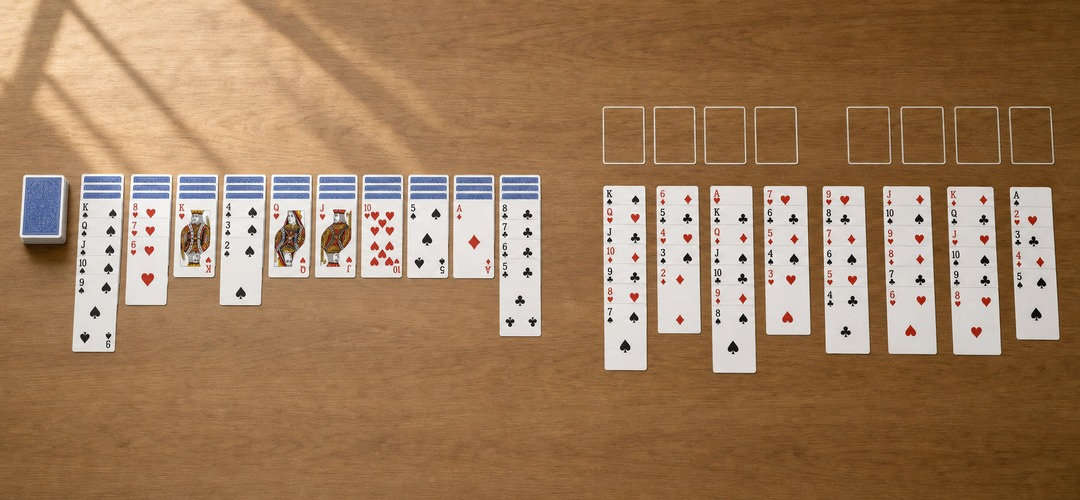
Castle Solitaire is played with a single standard 52-card deck. The layout is what gives the game its name — the four foundations sit in the center like castle keeps, with two "wings" of cards stretching out on either side.
- The four Aces are removed and placed vertically in the center to start the four foundations, one per suit.
- The remaining 48 cards are dealt face-up into 8 columns (rows) of 6 cards each — four columns to the left of the foundations and four to the right.
- There is no stock pile and no waste pile. Everything you need is visible on the table from the very first move.
Only the exposed card at the open end of each column is available to play. You move one card at a time, either onto a foundation or onto the end of another column. Every card is face-up, so there is no hidden information — the entire game is in front of you.
How to play Castle Solitaire
The goal is simple: move all 52 cards onto the four foundations, building each one up in suit from Ace to King (A, 2, 3 … J, Q, K). When all four castles are complete, you win.
Here is how play works:
- Play onto the foundations. Move the exposed card of any column onto its matching foundation when it is the next card in sequence — for example, place the 2 of Hearts on the Ace of Hearts, then the 3 of Hearts, and so on.
- Rearrange the tableau. Move an exposed card onto the end of another column when it forms a sequence. This is where Castle Solitaire differs from its ancestor: you may build up or down, regardless of suit. A 7 can go on top of a 6 or an 8. That single "up or down" freedom is what makes the game much more solvable than Beleaguered Castle.
- Empty a column. Once a column is completely cleared, the empty space becomes a wildcard slot — you can place any card there, giving you room to maneuver blocked cards out of the way.
- Win the game. Keep unblocking and building until all 52 cards have climbed onto the foundations from Ace to King.
Because there is no stock pile to fall back on, every move counts. Think before you commit a card to a foundation — sometimes it is smarter to leave it in the tableau a little longer.
Castle Solitaire vs. Beleaguered Castle
Castle Solitaire and Beleaguered Castle share the same board, so they are easy to confuse. The difference is one rule — and it changes everything about how the game feels.
| Feature |
Castle Solitaire |
Beleaguered Castle |
| Layout |
8 columns of 6 cards, 4 Aces pre-placed |
8 columns of 6 cards, 4 Aces pre-placed |
| Tableau building |
Build up or down, any suit |
Build down only, any suit |
| Stock / waste |
None |
None |
| Difficulty |
Easier — more recovery options |
Harder — one wrong sequence can trap you |
| Origin |
Modern, easier variant |
First published in 1883 (Dick's Games of Patience) |
| Typical win rate |
Higher (very forgiving) |
~24% |
In Beleaguered Castle, you can only build tableau sequences downward, so a low card stranded under a run of high cards can be almost impossible to free. Castle Solitaire lets you build in either direction, which means you can shuffle cards back and forth to dig out exactly what you need. If you enjoy the castle layout but want a gentler, more winnable experience, Castle Solitaire is the version to play.
Castle Solitaire win rate and difficulty
Castle Solitaire sits at the easier end of the "open" solitaire family — games where every card is visible from the start. Its close relative Beleaguered Castle wins roughly 24% of random deals, and Castle Solitaire is more forgiving still, thanks to its up-or-down building rule. With careful play, a large share of deals are solvable.
Because all cards are face-up, Castle Solitaire is driven far more by skill than by luck. There are no surprise cards waiting in a stock pile, so nearly every loss can be traced back to a decision rather than a bad draw. On Solitaire 365, our version is designed to deal only winnable games, so the outcome is always in your hands.
Castle Solitaire win rate vs. other solitaire games
| Game |
Approx. win rate |
Luck vs. skill |
| FreeCell |
~99% solvable, ~41% player wins |
Mostly skill |
| Castle Solitaire |
High (forgiving open game) |
Mostly skill |
| Beleaguered Castle |
~24% |
Mostly skill |
| Klondike (Turn 1) |
15–55% |
Mixed |
| Spider (4 suits) |
5–20% |
Skill-heavy |
| Pyramid (strict) |
1–2% |
Heavily luck |
Win rates vary by platform, ruleset, and player skill. Open games like Castle Solitaire and FreeCell reward planning because nothing is hidden.
Does skill affect your win rate in Castle Solitaire?
Yes — more than in most solitaire games. Since every card is on the table, experienced players can read the whole board and plan several moves ahead. The two habits that separate winners from beginners are keeping at least one column empty for maneuvering, and resisting the urge to send cards to the foundations too early. On guaranteed-winnable deals like those on Solitaire 365, thoughtful sequencing is the single biggest factor in whether you win.
Tips and strategy to win Castle Solitaire
Free the low cards first
Your Aces are already on the foundations, so your very next targets are the 2s, then the 3s. These low cards are often buried under higher ones, so plan how to expose them early. The faster your foundations climb, the more room you free up across the board.
Guard your empty columns
An empty column is the most valuable asset in Castle Solitaire — it acts like a free cell where you can park any card. Try to clear a short column early, and avoid filling an empty column unless the move genuinely advances your position. Keeping a space open gives you the flexibility to unblock trapped cards.
Don't rush cards to the foundations
It is tempting to send every playable card straight to a castle, but sometimes a card is more useful staying in the tableau. For example, leaving a 6 on the board lets you drop a 5 or a 7 onto it and free a card underneath. Move to the foundations when it helps you, not just because you can.
Plan several moves ahead
Because there is no hidden information, Castle Solitaire rewards forward thinking. Before you make a move, look at what it unblocks — and what it might trap. If you have unlimited undos (you do on Solitaire 365), use them to test a line of play and back out if it leads to a dead end.
Castle Solitaire variants
The castle layout has inspired a whole family of games. They all share the central foundations flanked by two wings of columns, but each one tweaks the building rules or the setup.
Beleaguered Castle
The classic original from 1883. Same 8×6 layout, but you can only build down in the tableau, which makes it noticeably harder than Castle Solitaire.
Streets and Alleys
Like Beleaguered Castle, but the Aces are not pre-placed — they are shuffled into the deal. This leaves the left columns with seven cards each and adds an extra layer of planning, since you must uncover and place the Aces yourself.
Citadel
A more forgiving relative in which cards can be played onto the foundations during the deal, giving you a head start before the game even begins.
Fortress (and Chessboard / Fives)
These variants use five columns on each side of the foundations and allow you to build sequences up and down in the same suit, changing the strategy considerably.
Magic Castle Solitaire (TriPeaks style)
Not to be confused with the foundation game — Magic Castle Solitaire is a different game built on the TriPeaks mechanic. Instead of building castles, you clear a tableau by selecting cards one rank higher or lower than the open card, with bonus cards, timed levels, and a running score. If you searched for "TriPeaks Castle Solitaire," this is the game you're thinking of.
Castle Solitaire vs. other solitaire games
Castle Solitaire belongs to the "open" family of solitaire, where all cards are visible from the start. That makes it a game of planning rather than luck — much like FreeCell — and quite different from draw-based games like Klondike or Pyramid.
Castle Solitaire vs. FreeCell
FreeCell is the most famous open solitaire, and Castle Solitaire feels similar: every card is visible and nearly all deals are solvable with good play. The key difference is the tools. FreeCell gives you four free cells to hold cards; Castle Solitaire gives you empty columns as your temporary storage instead. Both reward deep planning and rarely punish you with an unlucky draw.
Castle Solitaire vs. Klondike Solitaire
Klondike is the version most people simply call "Solitaire." It hides cards face-down and relies on a stock pile, so luck plays a bigger role. Castle Solitaire has no hidden cards and no stock — you see the entire board immediately, so a loss almost always comes down to a decision rather than the deal.
Castle Solitaire vs. Pyramid Solitaire
Pyramid is a fast, luck-heavy game where you pair cards that add up to 13. Castle Solitaire is slower and more strategic, built around sequencing full suits from Ace to King. Where Pyramid can be unwinnable before your first move, Castle Solitaire's outcome stays firmly in your hands.
| Game |
Core mechanic |
Suits matter? |
Decks |
Hidden cards? |
Skill vs. luck |
| Castle Solitaire |
Build foundations A→K, up/down tableau |
Yes (foundations) |
1 |
No |
Mostly skill |
| Beleaguered Castle |
Build foundations A→K, down-only tableau |
Yes (foundations) |
1 |
No |
Mostly skill |
| FreeCell |
Sequence with 4 free cells |
Yes |
1 |
No |
Mostly skill |
| Klondike |
Build suit sequences A→K |
Yes |
1 |
Yes |
Mixed |
| Pyramid |
Pair cards summing to 13 |
No |
1 |
Partly |
Mixed / luck |
Castle Solitaire — Frequently Asked Questions
How do you play Castle Solitaire?
Move cards one at a time from the eight tableau columns onto the four foundations, building each foundation up in suit from Ace to King. You can also rearrange tableau cards up or down regardless of suit. You win when all 52 cards reach the foundations.
What is the objective of Castle Solitaire?
The objective is to build all four foundations — the "castles" — from Ace to King, one for each suit. When every card has been moved onto its foundation, you have completed the game.
What's the difference between Castle Solitaire and Beleaguered Castle?
They share the same layout, but Beleaguered Castle only lets you build tableau sequences downward. Castle Solitaire lets you build up or down, which makes it easier and more winnable. Castle Solitaire is the friendlier, more beginner-friendly version.
Can every game of Castle Solitaire be won?
Not every random deal is solvable, but Castle Solitaire is very forgiving because you can build in both directions. On Solitaire 365, our version deals only winnable games, so a path to victory always exists.
Is Castle Solitaire free to play online?
Yes. You can play Castle Solitaire free at Solitaire 365 — no download and no sign-up required. It runs in any desktop or mobile browser and includes unlimited undos and guaranteed winnable deals.
Do I need to download Castle Solitaire?
No download is needed. Castle Solitaire plays directly in your web browser on desktop and mobile. There is nothing to install and no account to create — just open the page and play.
How many cards are used in Castle Solitaire?
Castle Solitaire uses one standard 52-card deck. The four Aces start on the foundations, and the remaining 48 cards are dealt face-up into eight columns of six.
What is the win rate of Castle Solitaire?
Castle Solitaire is one of the more winnable open solitaire games. Its stricter relative, Beleaguered Castle, wins about 24% of random deals, and Castle Solitaire is more forgiving thanks to its up-or-down building rule.
Can you play Castle Solitaire on mobile?
Yes. The game is fully mobile-friendly and works in your phone or tablet browser with no app to install. You get the same features as on desktop, including fullscreen mode and unlimited undos.
Is Castle Solitaire a game of skill or luck?
Mostly skill. Every card is visible from the start and there is no stock pile, so planning and sequencing decide the outcome far more than the shuffle. Careful play wins the large majority of games.
Who made Castle Solitaire?
Castle Solitaire is a modern, easier variant of the 19th-century Beleaguered Castle. It was popularized as a digital card game by MobilityWare, and you can now play it free in your browser on Solitaire 365.
What is Magic Castle Solitaire?
Magic Castle Solitaire is a different game that uses the TriPeaks mechanic — you clear a tableau by picking cards one rank higher or lower than the open card, with bonus cards and timed levels. It is not the same as the foundation-building Castle Solitaire on this page.